Wednesday, July 25, 2012
Object Lesson
It is long, but well worth it. All links in the body inserted by author.---Ed.
Read more of Storey Clayton's work here at the Blue Pyramid. Check out the insights of his famous cartoon Duck and Cover, here on the Clarion Content. See and take the Blue Pyramid's legendary Book Poll here.

**************************************************
Object Lesson
by:Storey Clayton
I have learned a lot about myself in the past week. This is good. Learning is fun!
One of the things I have learned, or relearned perhaps, is how little I am surprised by things. Most people like surprises. I kind of miss them, I guess. Which is not intended as a way of tempting the fates. But if anything, I think I'm surprised that there aren't more mass-shootings in America. About one a day is probably what I'd expect. Maybe we'll get there soon. This is not a desire or a hope. It would be nice to have no mass-shootings in a year. But there would have to be a lot of changes to make that happen.
No, not increased security measures.
I wrote at length about the Occupy Wall Street phenomenon last October, how I saw it as a harbinger not of a revolutionary protest movement in our society, but as a reflection of how many people were left with nothing to do in our society. It would be nice if it were a revolutionary protest movement that was burgeoning in our society. Unfortunately, we have all seen too many revolutionary protest movements. We are watching several of them now! Look at Libya, Egypt, Syria. Meet the new boss, same as the old boss. A bunch of people get themselves killed and do some killing and you end up with a society that looks a lot like it did before. But the leaders are slightly different and maybe this race or religion or sect has the advantages to lord over the prior victors. There is much to deter a young revolutionary in society today.
To believe in revolution, you have to believe in the future. You have to believe that there is a future worth fighting for. We are getting little stark illustrations all over the place that this is a foolish perspective. There will be a future, surely, in the sense of days that follow this one. No matter how much caves in or how much I lose, that is inevitably clear. But the idea that the right people can be in control, nay, that there even are right people, seems unlikely. And the more people who were raised and brought up to believe in an American dream and a future that was better than their parents' and the mass accumulation of growth and so on and awaken to find the piles of debt and futurelessness waiting for them, the more people they are likely to go out and shoot.
I probably shouldn't put in print that I understand that frustration and powerlessness of mass-shooters. I am a pacifist, of course, and abhor violence of all kinds, and am in no way trying to justify or vindicate the actions of James Holmes or anyone like him. But I get the idea of the world being so backwards and upside-down that only an absurdist and horrific reaction seems fair or justified. I have felt this way in my life sometimes and am very grateful to my pacifism for keeping me from stockpiling weapons. I know that some of you are probably surprised (there it is again!) to see me writing this, but I think you are not necessarily checking in with yourself sufficiently if so. Look inward, my friend. Have you never felt that kind of anger and despair?
This society is manufacturing anger and despair at an incredible rate right now. We've been over why, this worship of the magical "Economy", and we've even been over how it manifests when people only turn the proverbial gun on themselves, most recently. As my friend and debater Kurt Falk often tells me, I should be the entertainment at children's birthday parties. His idea for fixing all this is in his most recent post, where he joins Kurt Vonnegut (in Palm Sunday, just finished today, certainly influencing the style of this post) in advocating that we have new rites of passage for American youth, bar mitzvahs or quinceañeras for a culture unmoored. It's a good idea. It used to be that graduating from high school was our culture's adulthood commemoration ceremony. But now there is no real adulthood to be reached. In the sense of independence, of self-sufficiency, of freedom to make informed decisions, our newly minted adults are as bankrupt as someone with six figures of student loan debt. And just like those folks, they can't file it and start over.
So they shoot people, don't they? I guess that's a little oversimplified, but that looks to be the size of it. Apparently Mr. Holmes is walking down the corridors pretending to be the Joker or some other masked movie villain (get it?), but I'm sure he was perfectly sane when he spent meticulous hours buying guns on the Internet or laying tripwires across his apartment. He did the math. He was good at it. He realized that he had no future, that the people of America who were being distracted to death had no future, and he tried to illustrate that. All the way down to the six-month-old and the six-year-old who were apparently watching one of the most violent franchises in movie history after midnight.
I am not trying to glorify this scumbag or turn him into some sort of dark anti-hero (I'll leave that to Hollywood). But I am trying to dissent from the media chorus singing about the senseless unpredictable shock of all this. It's perfectly predictable and it has a kind of logic. Michael Moore did much the same treatment of Columbine in his masterpiece movie Bowling for Columbine, which we should all probably go rewatch. Part of his thesis was that kids growing up in the shadow of defense contracting, preached to about how the country they're supposed to love solves all its problems through violence, will occasionally take this environment seriously. And respond in kind. People are all agog about what's wrong with Colorado when Michael Moore already told you. To be fair, Holmes did hail from San Diego, one of the biggest military cities in the country aside from those found in Colorado. When we have a society filled with people who play a little video game attached to real drones that blow up real people, how shocked can we be that disgruntled broke teens or twenty-somethings from the new Lost Generation walk into a movie and emulate the solutions found on-screen and in real life?
What no one seems to realize is that you need to do something with these people. I don't mean to sound pejorative when I say "these people" - many of them are my closest friends and confidants. I coach them, I talk with them, I worry about the very concept of a future around them. They need things to do. They have active minds and have been raised on poisonous dreams about growth and accumulation. They need to put their mind to something other than disappointment, despair, and the soulless thresher we call "The Economy".
Many would suggest a war. I have no doubt that's one plan being hatched in the corporations funding the Obama/Romney campaign. A nice big war to sweep everyone into the old employer of last resort. You wouldn't even need a draft, you'd just have it de facto. I'm sure a land invasion of Iran or North Korea would keep many hundred-thousands of a Lost Generation occupied and out of the way. The legend is that this is what saved America from the Depression, what saved the Baby Boomers from totally overwhelming the system in the sixties. There's little doubt that part of the lack of enthusiasm to really make jobs and work for the youth of our society has to do with making the incredibly unappealing military look a little more enticing.
I, of course, would never suggest a war, any more than I would advocate you going down to your local movie theater and shooting up six-year-olds. They are the same thing. Only in a war, more six-year-olds die. Usually more horribly, more painfully.
I would suggest make-work programs. We certainly have things that need fixing. Let's build a free wireless Internet network for the whole nation. Yes, even rural North Dakota and Alaska. That would require some people, wouldn't it? Give them room and board and a college-like camaraderie, a little spending cash (so they can - gulp - see a movie), maybe access to a shared fleet of cars on weekends. Let's build some high-speed rails so we can take all these dangerous overpriced gas-guzzling trucks off the road. Let's build some solar and wind plants. I know, I know, it would require a total resignation from the very concept of The Economy. It would mean government was actively putting corporations out of work, and some of their employees too, and treating the youth of America with dignity and respect and like they're people who can do things. Heaven forbid.
But what are your alternatives? These people are going to be on the dole one way or the other. There aren't jobs, there aren't opportunities, and everyone in The Economy is doing their damnedest to make sure there are fewer jobs and fewer opportunities to come. I guess you can repeal minimum wage and make everyone punch each other in the nose for a scrap of bread you throw from the tower at midnight, but these people are increasingly going to leverage their debt and take matters into their own hands. And they'd have to believe in a future to make a revolution. If all they believe in is despair, then you get Aurora or Columbine or Virginia Tech. You get little dark knights everywhere, believing they are extolling some kind of neo-nihilism with every bullet, not realizing governments cornered that market with wars centuries ago.
I envisioned this post a long time before there was a movie theater shooting, and it was going to be about another kind of object lesson, back to the theme of learning about myself. It was about the fact that I bought a new coffee maker I didn't need a few months ago and haven't had the heart to set it up and replace the old one.
The old one looks like this:
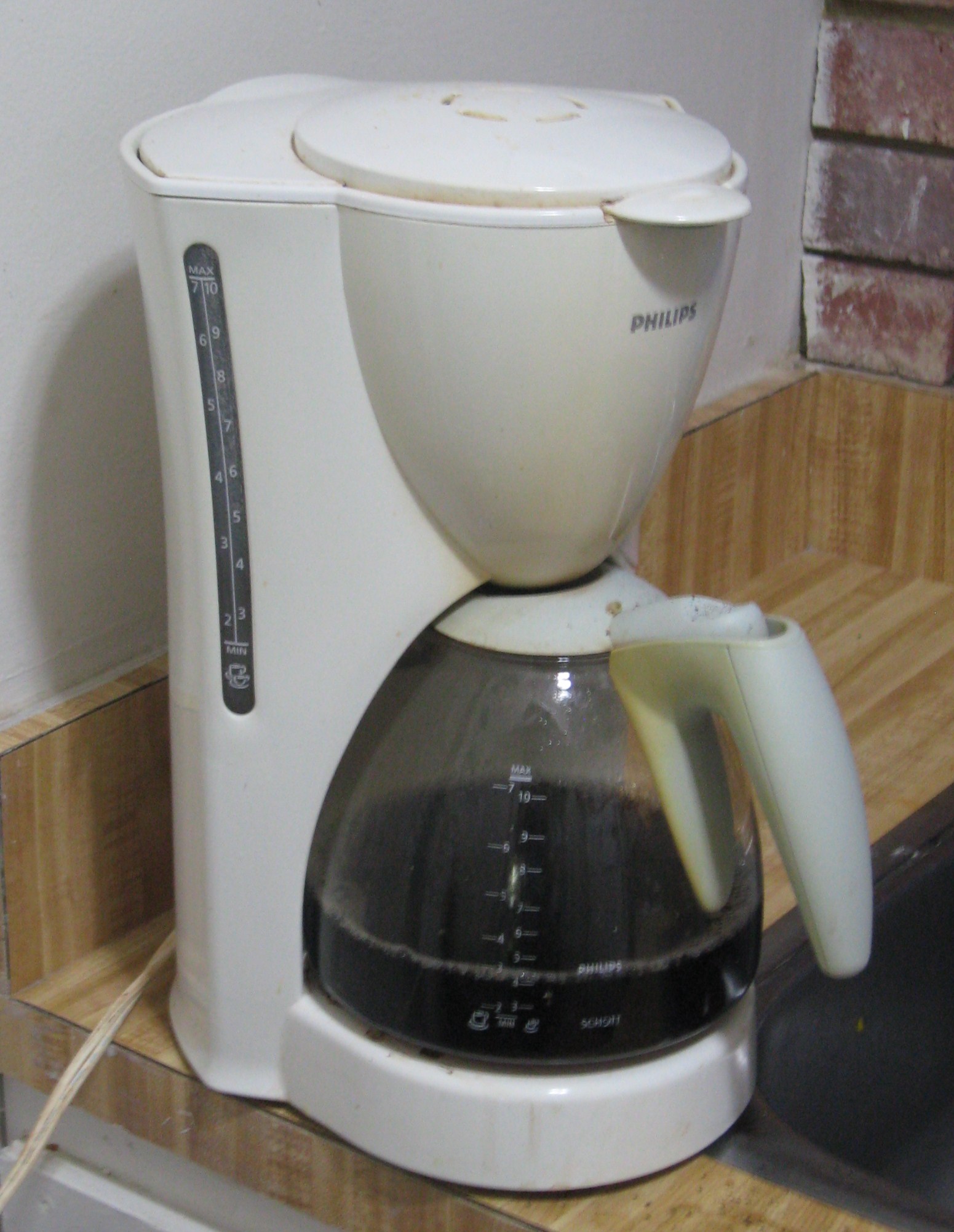
I won it at the Yale tournament in the spring of 2002. They gave out useful or fun objects like rice cookers and Gameboys and coffee makers with the budget they would have spent on shiny trophies. I actually initially took the rice cooker at Emily's behest, but quickly swapped it for a more practical (for me) coffee maker with Steph Tatham, who'd won some lower award. The thing has worked perfectly for a decade. It's a relic of an American era of making machines that lasted, even though it didn't come from that era at all. I've probably had six-thousand or so cups of coffee out of this thing. It still worked perfectly this morning.
My intent was to replace it with this model that I got at Target for like twenty bucks:
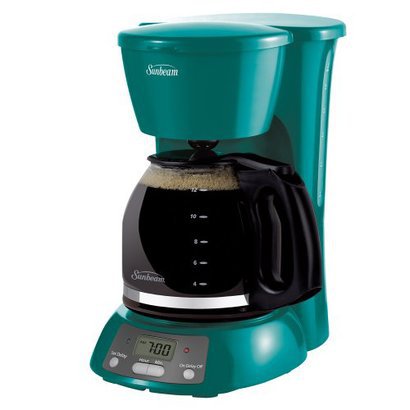
It shouldn't take much imagination to see why I picked this out. The color is like the font of this page, the color I would pick for nearly all objects out of a pantheon of a thousand hues. It has a timer so that it will brew the coffee for me and have it ready when I blearily awaken at six in the morning to go to a tournament or fulfill some other wakeful task of existence. It is in every way perfect. Whereas the old one is dingy, off-white, wearing the stains of thousands of brews, incredibly simple in its design. It doesn't even have digital numbers! In an era where you can't dry your hands in public without interfacing with a motion-sensor, holding on to this thing is as old-fashioned as not having a cell-phone (I'm coming up on two years with a cell-phone!).
And yet I can't seem to make the transition, to get rid of the old thing. It was free. It has served me so loyally for so long. It still works.
I am such a bad capitalist.
Or maybe, to borrow a phrase, I'm just committed to commitment.
Maybe we just need to take everyone in the Lost Generation and have them paint our coffee makers. Have them fan out in the neighborhoods, house by house, and ask what everyone would like updated or changed or painted or retooled so that life feels new and fresh again. So that it feels like there's a future that's not just austerity and decline. So that people can feel like a rich person without actually being decadent or aspiring to buy and sell people.
That kind of house-by-house work sure beats the hell out of what that phrase is being used for in Afghanistan right now.
Labels: 2012 presidential election, Economy, Guest columns, Politics, public protest, thought
Monday, July 23, 2012
Rappers Won't Clock-out: Why Hip-hop is No Longer Timeless
by: Mimi Mendouga
courtesy of: the East Side Perspective
The East Side Perspective, a Clarion Content partner, is an up and coming sports and music website published in Chapel Hill.
For more great articles from the East Side Perspective, check here.
----------------------------------------------------------------------------------------------
If there’s one thing we’ve learned in the past few years, it’s that hip hop is not dead. And if it ever was, we’re definitely experiencing something like an Easter period. Thanks to the emergence of artists like Wale, J. Cole, Kendrick Lamar, and many more it may be safe to put the entire debate to rest.
For now, hip-hop is well and alive. But I’d like to raise a greater woe. Correct me if I’m wrong, but hear me out first. It’s been a while since hip-hop has been timeless. And if you ask me, the mix tape revolution is to blame for it.
By timeless I mean just that. I can’t pinpoint the exact moment it started happening, but songs have begun developing a “sell by” date--–like what

you see on the milk containers. It’s an unfortunate phenomenon that retired and dead rappers from eras like Big Pun’s, and the Beastie Boys’ are fortunately sheltered from.
When I say mixtape revolution – I’m talking about the moment when mixtapes stopped being a means to establish street buzz before the mainstream sting, and started being a way for established artists to stay relevant and milk their success of the moment. (*See Lil' Wayne). It also became an approach for new or aspiring artists to push through the boundaries that exist when you aren't financially backed by a big-time record label.
So what happens after a song’s sell by date? Nothing. Just like a gallon of milk, you can still drink it, you just probably won’t find it in stores, or in this case, the radio; and it’s more than likely that by then, you, as well as the store have replaced it. You can still listen to it – enjoy it even, but you know it won’t be around much longer.
Meanwhile, the music industry and rising artists everywhere have pumped out a flood of new projects, which you, as a music lover, are required to stay on top of.
Ultimately, artists are fighting to stay relevant by producing and putting out more and more music. The consequence? Songs reach their sell-by date fairly quickly, and are drowned out by new material. Not only are we, the consumers, given less time to enjoy and process the music; but, the fear of fading-out puts pressure on artists to keep releasing new music to stay afloat – sometimes sacrificing quality.
My point is, the music industry has become the music factory. Rappers are using an ‘economies of scale’ approach to music production–--and we’re all losing in the process. The mixtape industry is the new Wal-Mart of hip-hop, where artists routinely put other businesses, meaning artists, out of business; offering us an overwhelming quantity in exchange for durability. In other words, yeah sometimes we get good music, but it’s forgotten the second we get something else.

Quick scenario. You’re going down the highway, and the DJ starts playing Drake’s “Best I Ever Had.” Fifty bucks says you’re now stale-facing the radio, and probably upset that you have yet to hear him play the newest Kendrick. Not necessarily because one is better than the other – but because let’s face it, the song is old.
Would you be thinking the same thing if Dr. Dre and Snoop’s, “Let Me Ride” came on? Won’t your children recognize Biggie’s “Big Poppa” before recognizing Rick Ross’ “Blowin’ Money Fast”? Both were hits of equal magnitude in their era, though I bet you’d forgotten the latter until I brought it up. Today’s music is coming at us like baseballs out of a pitching machine in a batting cage. Whoosh. Whoosh. Whoosh. We just don’t have the time to appreciate the last hit before we are supposed to be ready for the next.
I digress. Don’t get me wrong. Mixtapes can be a great tool, specifically for upcoming artists. They can be a rapper’s resume and an opportunity to practice and present an organized body of work. But the overwhelming number to which we’re exposed takes away from the time we have to appreciate them – something that usually leads to being able to enjoy the music equally, if not more, later in life.
Just this year 50 Cent has released two mixtapes and is releasing an album. That’s roughly thirty-five songs from one person, in one year. Excluding features. Why? I’m a huge 50 Cent fan, I've listened to both tapes thoroughly… and remember two songs.
I’m not suggesting we kill mixtapes altogether. I’m just wishfully thinking and hoping artists scale back on quantity, focus only on quality, so we – the fans – can have durability. Don’t sell out to meet the sell by date, and stop give us more than we can handle. Otherwise your music is sure to spoil.
Labels: Durham, Eastside Perspective, Guest columns, music, Pop Culture
Did You See Me Catch that Foul Ball?
We will be running a "Vox Populi" reader submitted column, on any topic you would like. Amaze, delight, shock our audience. We dare you. And similarly, we will be accepting your Durham picture submissions for a special regular feature.
Our guest writer, today, is a fiction raconteur who fancies this popular new format of the moment, called flash fiction. A brief bit of razzle-dazzle and you're done is their modus operandi, super short fiction.
In this piece, our guest author has seized upon one of the Clarion Content's favorite topics, baseball. A flash fiction piece about baseball in the future, we know, we know, you all are already probably thinking: no umpires, electronic scorekeeping, et cetera. This author strikes out in a totally different direction.

Did You See Me Catch that Foul Ball?
by: A. I. Wright
I work for a company that sells clips of people who catch foul balls. They make good money.
We have the interns record and then electronically mark the telecast of every Major League Baseball game each time a fan catches a foul ball and their face is visible for at least two seconds. Surveys have shown most people won't buy unless their face is on for two seconds.
Then, thanks to some excellent facial recognition software and a little data mining deal with one of the big secondary ticket broker sites, pennies per name, we are able to email them an offer to purchase the clip. We will upload it on-line to our site, licensed by MLB, for one fee or we will email them a video file for a slightly larger fee.
You would be amazed how many foul balls there are in fifteen Major League Baseball games a night. Unfortunately, on a lot of them, we don't get the money shot. Next year, we are not only going to get the telecast feed, but the game film from all the other camera angles, too. It should double or triple the available number of clips, and thus revenue.
Cha-ching.
The sublime part is most people don't even ask these days how you connected the foul ball footage to their email address to make them the offer. And ninety-eight percent of those that do ask, we are able to put off with a simple, "Your tickets."
What a wonderful world.
Labels: fiction, Guest columns, technology
Tuesday, June 26, 2012
7 Ways to Recreate an Idyllic Childhood Summer
by: Aubrey Menard
courtesy of PolicyMic

One of the most difficult things about transitioning from being a student into a full-fledged adult is the loss of summer.
You no longer have the end of the school year to look forward to—a break from the tedium of everyday life, a chance to hit the reset button on your academic performance, throw away the disorganized trapper-keeper, and forget all the math you spent the year learning.
But more than that, if you’re in a permanent sort of 9-5 (or 9-5+) job, you may miss out on the adventure that the lazy, hazy days of irresponsible summers once held. Below are seven ways to try to recapture a modicum of summer’s former glory and have yourself a great few months.
1. Get your feet unreasonably dirty: Remember coming home from a long summer day of playing outside? Your parents might yell at you to go spray yourself down with the garden hose before you were allowed to enter the house. The cold water would run over your body, making mud on your skin because the layer of dirt was so thick. You would go the entire summer never being able to get your feet truly clean because the dirt was so ground into them.

This summer, play outside, often and barefoot. Play wiffle ball, bocce, volley ball, and red rover. Go for walks and feel the grass beneath your feet. Walk on the pavement and hop around looking for shady spots because the bottom of your feet are burning. Black-bottom feet are the sign of a summer well-lived.
2. Stay inside and feel guilty about it: Summer is glorious, but summer is also mind-numbingly hot. Back when we were kids, before air conditioners were ubiquitous, a summer day often meant lying on the cement floor of the basement with ice packs on your body, trying desperately to cool down. If your parents left you alone while they were at work, maybe it meant breaking the rules and playing hours of Mario Brothers inside instead of finding ways to entertain yourself in the boiling hot sun.
This summer, give yourself a little time inside. Pull all your shades down to block out the heat and watch some Netflix. Be lazy. But don’t do it too often, and feel badly about it when you do, because it’s the summer, and your parents were right, you should be outside.
3. Experience the magic of a summer night: In our younger years, the combination of not having to be up for school in the morning and a delayed sunset meant one very significant thing: a later bedtime. Staying up on summer nights meant being enchanted by fireflies, singing songs by a campfire, and laying in the back yard, looking up at the stars.

These wonders cemented our impression that the best things happen after we normally would have to be in bed.
This summer, stay up late and enjoy the night. Instead of going to the club or bar, spread a blanket out in your yard, on your roof, or in the bed of a pickup truck, and stare up at the night sky. Go on a camping trip and sing songs while roasting marshmallows over a fire. Go to a drive-in movie theater. Pack a picnic and watch the fireworks. Get bitten by mosquitoes and catch lightning bugs in a jar.
4. Don't care about your beach body: Corn on the cob. Hot dogs. Lobsters. ICE CREAM. Need I go on? Summer food is delicious. You used to eat it by the pound without ever thinking about it because you were playing outside so much you needed all those calories!
This summer, let watermelon juice drip down your chin, and get buttery, salty corn on the cob stuck in your teeth. Go for ice cream as often as possible—but ride your bike to go get it, or chase the ice cream truck down the block. If you’re heeding the earlier advice, you’ll be so active that you’ll burn the extra calories and look great when it comes time to go to the beach.
5. Get wet: Water defines the summer. As a kid, you were the coolest cat in the neighborhood if you had a pool in your back yard. No pool access? Well, you could always run through the sprinkler, have a water balloon or super soaker fight.

Maybe you were lucky enough to live near the ocean so you didn’t need to experience the torment of a sunburnt, sandy ride home from the beach in a crowded mini-van. Whatever your summer experience, it undoubtedly included water.
This summer, get soaked. Don’t worry about ruining your makeup, hair, or clothes. Go swimming as often as possible. Get caught in a downpour and dance in the rain. Find a swimming hole and rig a rope swing up to a tree. Grab some friends and go tube down a river.
6. Rock out: When you were twelve, your favorite band was probably Hanson or something similarly awful. But, imagine if your twelve-year-old self got to go see said band live in concert? WOW. You would be so thrilled that you’d listen to nothing else on your disc man than MMMBop on repeat until the day had finally come.
Now that you’re an adult, presumably you like better music. And, you have the self-determination to go see this music live without the benevolence of your parents. So, go! Dedicate a few days to, enjoying your favorite songs and discovering new bands at a music festival. If you don’t have that kind of capacity, at the very least get yourself to an outdoor concert. Don’t be too cool for school!—be enthusiastic about it, listen to your favorite band right up until show time, and memorize all the lyrics. If your twelve-year-old self could see you, s/he would think you’re so rock and roll.
7. Fight the ocean: When you’re living summer to its fullest, you will never want it to come to a close. If your parents sprung for Nickelodeon and you could watch The Adventures of Pete and Pete you may remember the iconic scene of Little Pete and his superhero, Artie, violently punching the ocean, trying to prolong summer just a bit by beating the changing tide into submission. As the older Pete narrates, “They’re not crazy, they’re just angry, angry that the summer has to end […] Every year, it seems the summer is over ten seconds after it started…especially this summer.”

Have the best summer you’ve ever had. Go on adventures and act like a child. Enjoy the beauty of the natural world and the company of your friends. If you’re doing it right, the summer will fly by in what seems like seconds and come Labor Day, you will find yourself wading into the tidal waters, fighting the ocean for just a little more glorious summertime.
Labels: Guest columns, Pop Culture, weather
Sunday, June 24, 2012
ADF: The Real Deal
If your reaction isn't, "No sh*t, that's amazing! We are so lucky, right? I find a way to go at least once every year," you need to read below.

Keigwen + Company
One more reason to be proud to be Durhamanian. Occasional Clarion Content guest columnist and accomplished writer, Amber C. Crews breaks its down.
"ADF: The Real Deal"
-Amber C. Crews
Admission: This is my fourth summer in Durham, a town I love and barely leave, and before last night I had never gone to an ADF performance. Not one. Marked by posters and attractive dancers around town, the conversation always went like this: "So, ADF is here again. How much are tickets? That much? What would we see? Uh – want to go to Dos Perros instead?"
Without anyone personally vouching for a performance and my lack of investment in modern dance (which is not the same as enjoyment), I’ve been unattached and clueless about this really awesome thing down the street. That all changed last night thanks to a mom I babysit for. She called me Wednesday and left a message: Hey, I just saw this fantastic performance and for some reason it made me think of you. If you’re available, I’d love to buy you a ticket.
How could I argue with that? I promptly called her back, thanked her profusely, and picked up my ticket at will-call for the Keigwen + Company show last night. After the jaw-dropping opening dance, my first thought was, Why have I never done this before?! The almost two-hour show flew by. I wanted to push rewind and watch it all over, from the beginning, right away. And that’s the magic – the dancers are so close, there, in tight clothes or naked, so present. No screen, barely any props, just bodies moving in space with indescribably captivating power. I was absolutely blown away.
Until the seal was broken, I had no idea that $30 was a steal for world renowned modern dance companies that you rarely get to see. That, in fact, budgeting a hundred dollars or more to see several shows every summer is well worth the investment in an institution that has been in little ole’ Durham before it was one of the hip, top-of-a-lot-of-stuff cities in America.
The mom knew what she was doing. Now I’m hooked. I just watched all the videos for the other dance companies and am trying to narrow down how many I can afford in the next month. I feel a bit bull-headed it’s taken me this long, but am thankful someone got through to me, even if it meant making it free. Sad how arbitrary money priorities can blind you, but now I know. If you like dance at all, buy a ticket today. You won’t regret it.
Labels: Art, Durham, Guest columns, Pop Culture
Saturday, June 16, 2012
Summer Herb Bounty Becomes Pesto-lite

you may be interested a use for all that overflowing basil. Check out this guest post on a lightened up version of pesto, courtesy of Scenes from My Lunch Hour.
With all the rain we've had of late, my herb garden has exploded. Seeing all that basil of course created an instant pesto-craving. Since pesto is kind of a fattening recipe, as far as sauces go, I decided to try to lighten it up a bit.
First I gathered a bunch of basil and parsley from my garden. I figured having a bit of parsley in there mellowing the basil would help to counteract the fact that I was going to add some sharp tastes (garlic and lemon, among others). Into the food processor went basil, parsley, garlic cloves and walnuts (they are cheaper and healthier than pine nuts and work just as well!) In addition to zesting the lemon, I also squeezed a few tablespoons of lemon juice into the food processor to replace some of the oil. Then the ever-delicious parmigiano-reggiano cheese. Instead of using a cup of extra virgin olive oil (like these proportions would normally call for), I only used about 2/3 of a cup (maybe even a little less) because of the lemon juice. Rather than just dump this in, I poured it in slowly through the mouth of the food processor while the herbs, nuts and cheese were spinning. I think this helped me be more stingy because it made use of the liquid as needed. The finished pesto came out to the perfect consistency:

While I was assembling the pesto and boiling the pasta, I had decided I needed to add some veggies so it was not all carb, nut and cheese. I quick trimmed some green beans and halved some cherry tomatoes, tossed them with salt and pepper and a teensy bit of olive oil, and threw them in the oven for 13 minutes at 400 degrees. Here’s a before and after shot:

And here's how the whole dish looked when put together:

Here's the full recipe for the pesto:
Summer Pesto-lite
Ingredients (pesto): - 3 cups fresh basil - 1 cup fresh parsley - four garlic cloves, crushed, peeled and cut in half - zest from 1 medium lemon - 2 to 3 tbsps lemon juice - 3/4 cup shelled walnuts - 1/2 cup parmesan cheese, grated - 1/2 tsp salt - 2/3 cup extra virgin olive oil
Directions: blend all ingredients in food processor until smooth. stop a few times and push the non-blended herbs down from the sides of the processor with a spatula. This will make 2x the sauce you need for the pasta & veggie portions below. My friend Jeff cleverly recommended using the extra on sandwiches, in dips, or (my personal fave) on a homemade pizza.
Check out Scenes from My Lunch Hour for more pics.
Labels: food, Guest columns, photos, Recipes
Wednesday, June 06, 2012
One lonely Beastie I be...
Special to the Clarion Content
from esteemed guest columnist: Al G. O. Escritor

Warning piece includes PG-13 language...
For the first time the other night, Johnny Ryall made me feel sad instead of joyously celebratory.
I am still trying to contextualize the death of Beastie Boy Adam Yauk.
I say contextualize because I don't think I will ever just get it and put it behind me. Our understanding of death has a time lag that drags well out behind our own relative age.
I remember my parents telling me that John Lennon had died. I didn't really know what that meant. I still had four grandparents and my first dog. Death hadn't really brushed up against me yet.
What does it mean when a great musician dies?
Not much when you're nine.
In high school I used to tease my friend Wheeze, a bassist and a huge Led Zeppelin fan, I would come into the cafeteria for lunch at least once a week and announce that I had just heard Jimmy Page had perished in some horrible mishap, car, plane, train accident, poisoning, lightning strike, et al. Wheeze's reactions ran the gamut over time from horror, to faux horror, to distaste, to boredom.
I don't think either of us really understood then what it means to lose a great musician permanently. You have to see "Almost Famous" a few times first. You have to read some Chuck Klosterman talking to, with and about musicians. You have to get f*cked up a few times and think about your relative place in the universe.

I had the Beastie's "Paul's Boutique" on cassette tape. It was revolutionary, powerful.1 The music was revolutionary for its time because it had so many samples, mad stuff of a length and variety that could never be duplicated in today's copyright happy environment. The drop that is the first twenty seconds of "Car Thief" was like nothing our suburban Jersey minds had every heard.
I even actually played "Paul's Boutique" to my little brother and sister, who were eight and six at that time. I have a distinct memory of having driven them somewhere in our parents Dodge Caravan and we were waiting outside somewhere to pick up our other sister. I switched off my mother's classical WQXR and popped in the tape. I have never brought this recollection up to them, so I have no idea what if any impression it made. To me it was seminal.
But I wasn't thinking about that moment a few years later watching The Beastie Boys at the Free Tibet Festival in Golden Gate Park. I was there with some 200,000 of my closest friends. I remember it being a beautiful warm, mild day for San Francisco in the Summer.
The two day long event was amazing. It included everyone: from Rage Against the Machine and the Red Hot Chili Peppers to the Foo Fighters and A Tribe Called Quest. Fortunately, Golden Gate Park's splendid, lush, plant life and stately architectural features were behind fenced off areas. Because, during the Beastie Boys set, there appeared the biggest mosh pit I have ever seen.
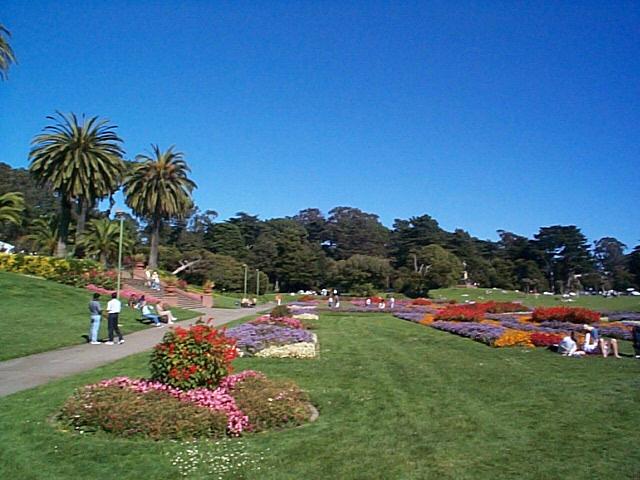
This mosh pit or mini riot, depending on your perspective, involved easily 1,000 people charging around kicking the sh*t of each other in a swarming vortex that had to be 100 yards deep by the width of the stage.
During Heart Attack Man, as the crowd from behind us surged, we were jostled every closer to the mosh pit. People would literally suddenly want to be done and they would run out of the mosh pit pitch, sprinting past us, often battered, bruised, discolored and panting. It was a concert experience unlike any other before or since.
It was not long before, while living in San Francisco, that I had received with great sadness the news of Jerry Garcia's death. It had come like a bolt from the blue. Wait, what? Jerry's dead? I am still in single digits in Dead shows was one of the first things that went through my head. At the time I had two stickers on my American made clunker, a Dead head's Steal Your Face and the Beastie Boys.

Jerry was dead and I am still trying to contextualize it. I have never seen the Grateful Dead again. Neither has anybody else. My Dead shows still number in the single digits.
I did see the Beasties again, years later in Madison Square Garden from the sump comforts and safety of a luxury box. They were just as cool and perhaps even cooler than I remembered them. My buddy and I went over how epically legendary and revolutionary they were for us in an era where there were no songs we knew more daringly anti-parent than "No Sleep Til Brooklyn" and "Fight for your Right." We pointed out the Beasties had toured with freaking Madonna. We reviewed how even in the era after college when we were the uber-cool club kids rolling to NYC hot spots like, "Match," "The Limelight" and "The Wetlands" we rocked Paul's Boutique and Ill Communication.2
As the horizon gets shorter and the days blow by faster, I don't know if I would have gone to that Beatles re-union tour. I do know I sure wouldn't have minded having a chance to... and the Grateful Dead would still be touring today if Jerry's body could have held up to it.
But the conclusion I want you to take away from this tour down memory lane isn't maudlin.
Rest-in-Peace Adam Yauch.
Am I crushed that I will never see the Beasties again?
Hell yes.
But the message?
I have a friend, uber-professional, buttoned down, works at one of the local business schools. She tells the story of being a twenty-one year old undergrad at UNC-Chapel Hill, and seeing none other than Dave Matthews with about ninety other people in the Cat's Cradle.
Me?
By the time I saw Dave Matthews, he was playing amphitheaters.3
The message is get your ass out there and see some live music. Now. Check out some up-and-coming local bands. Is the word of mouth good? Is there an act from out of town coming through one of our many fantastic music clubs that people are raving about?
See them while you can.
Adam Yauk, I am glad I saw you while I could.
I know one day I will again jam out to Johnny Ryall.
Notes
1The Sergeant Pepper's of hip-hop.
2It didn't matter to us that they started as a punk band. We were stoked Kate Schellenbach was sampled on Shadrach. The Beasties and their label Grand Royal had introduced us to Luscious Jackson, whom we adored.
3Interestingly enough, he also played that huge Free Tibet show in Golden Gate Park.
Labels: Guest columns, music, Pop Culture
Wednesday, May 30, 2012
Summer Tech Tips
Summer's coming y'all! The weather is warming up nicely here, so here are my Summer technology tips to help you get the most out of your vacation, or staycation...
Don't let your smartphone lose its mojo

AirPlay: The new CD changer for Summer parties

If you can't go on vacation, work outdoors

Backup your data, especially before traveling


Labels: Guest columns, technology
Thursday, May 03, 2012
Company of Thieves and Grouplove
Guest Column By: Beth Mandel

Company of Thieves
Photo credit Scenes from my Lunch Hour
What I am most struck by as I enter Cat’s Cradle is how mixed the crowd is. Eighteen year-olds stand shoulder to shoulder with thirty-plus- somethings, both crowds unironically clad in canvas TOMS. I’m early, as I am perhaps more eager to see the opener, Company of Thieves, than I am to see Grouplove, technically the headliner of this tour. It’s not crowded yet, so I head up to the front and find a good picture-taking perch, a set of tween girls the only obstacle between me and the stage.
Before long a seasoned couple sidles up next to me. The woman, Allison, strikes up a conversation after she catches me taking notes. I observe that I am on the older side of this crowd, at a wizened twenty-eight. With a self-effacing laugh she tells me to hush up – she’s forty! She and her husband Matt, a cancer doctor, have been going to shows since Dave Grohl was still drumming with Nirvana. She went to Dave Matthews Band shows when they only cost a dollar. Though her fit frame belies it, she tells me she has three kids. The middle one is a nine year old whose preferred school outfit is an old world fedora, her Black Keys t-shirt and a tutu. Allison brings home a tee from every concert she attends for each of her kids. Her daughter’s two favorite bands are the Beatles and the White Stripes, and she’s crushed that they’re both broken up. I tell her to tell her daughter she’ll soon lose count of how many of her favorite bands have broken up over the years, and that she should instead feel good about the fact that she’ll undoubtedly be the coolest kid in her freshman dorm.
Before long, Company of Thieves takes the stage and Allison and I are instantly transfixed by the band’s glowing, magnetic centerpiece – Genevieve Schatz. Her band mates probably get tired of hearing this, since they’re all talented in their own right, but when COT is on stage there’s only one place the audience is looking and that’s at Genevieve. And really, what else can you expect from a rock band? What made Ozzy, Bono, or Mick great frontmen? Charisma – a tendency to draw the spotlight. And a solid set of pipes of course.
Genevieve has charisma and pipes in abundance. Her voice is an intriguing dichotomy – at once childlike and questioning and yet still soulful as all hell. When she sings, her whole body becomes involved in the effort. Her bony frame twists with the emotions she’s belting, her chest heaving like it may be ripped apart if she doesn’t excise what’s building up inside her. She is simply dressed, wearing a sheer ivory peasant blouse and skinny jeans that allow us see her serpentine gyrations. She is completely captivating. She pauses between songs only occasionally, like when she tells us the new song she is about to sing depicts our relationship with the environment. As she wails out “Gorgeous/Grotesque” she makes everyone in the room feel the conflict she’s illustrating. If she sang “Oscar Wilde” with slightly more twang and less wail then on Ordinary Riches (their freshman album from 2009), then it seems she was saving her wail for the closing number “Won’t Go Quietly” (from 2011’s “Running from a Gamble”). It was an explosion of feeling that perfectly closed an enthralling set.
After a quick set change, Grouplove took the stage. If COT was all about the lead singer, Grouplove is the exact opposite. Their lineup is democratically horizontal, and they share not only the spotlight, but the harmonies and melodies as well. Everything about this band screams equality, yet they are still permeated by dramatic individuality. Singer and guitarist Christian Zucconi wears a flowered t-shirt that Allison and I agree looks like a Laura Ashley couch, and then laugh about how most of the kids there won’t get the reference. Singer and keyboardist Hannah Hooper is like a slightly less ripened version of Genevieve, equally energetic and delightfully feminine, but lacking that radiating soulfulness. The band seems equally nascent, though their sound is well developed, their lyrics are a bit superficial: “Cruising on the highway with my friends, top down, and we're all on our way to the beach…Hot day, mid-June, naked kids, running wild, and free. It's summer time fun, relax and stay young.” By contrast, COT’s aforementioned “Gorgeous/Grotesque” spins this poetic yarn: “There's nothing more helpless or hopeless than the birds of the city streets, with the dirt on their heavy wings. In the evening, on my way to sleep, I hear them- screaming out into a bitter melody.” Still, it’s easy to see stylistic synergies between the two bands and their joint touring is a clever pairing.

Grouplove
Photo credit Scenes from my Lunch Hour
I leave the club shortly before Grouplove finishes, eager to go home and pen my review. As I turn the corner heading for the parking lot, I catch Company of Thieves scarfing down some pizza outside their tour bus. I stand in awe of Genevieve, even in such a casual environment. Searching for something to say while fully intimidated, I tell Genevieve something I once heard a radio DJ say: “You were like a Mexican jumping bean of energy out there tonight!” I see one of her band mates roll his eyes at this unoriginal pronouncement, but I hope she’ll be kinder. She is. She beckons me to sit next to her, and says between mouthfuls of white pizza (yum!), “Really? I don’t think I jumped enough tonight. I was afraid I’d crash into the drum set!” I agree with her that perhaps it wasn’t that jumpy, but it was certainly not lacking for energy. We chat for another minute, and not wanting to selfishly hog her time, I excuse myself and head out. Only later did I wish I had asked her for an autograph, fan-girl style. I’ll have to settle for enjoying my pictures instead. All in all, a great show.
Labels: Guest columns, music, Pop Culture
Monday, April 09, 2012
Justice is not blind
by: Alicia Towler

Today when I logged into my favorite news site, I saw the headline: “Poll: Trayvon Martin case divides U.S. by race, age, wealth, and politics.” The poll taken by the Christian Scientist Monitor reports that the country is split in its perceptions of the handling of the case and whether or not the crime was racially motivated.
When I logged into Facebook, I saw that yet another friend had shared this poorly reasoned blog post asking why people were so outraged at the shooting of Trayvon Martin but not the Eve Carson murder four years ago in Chapel Hill, North Carolina. The author argues that Carson was similarly racially targeted for being “a rich, blue-eyed, blonde haired, white girl” when she was kidnapped, robbed, and killed.
There are many differences between the two cases, but here are the core issues that make the comparison irrelevant:
When Carson was murdered, police worked quickly to identify her, find her car, phone, laptop, and wallet, and develop leads to identify her killers. Within days, police SWAT teams had stormed houses in Durham looking for the two identified men, Atwater and Lovette, and shortly after, both men were arrested, charged with 1st Degree murder, and imprisoned to await trial.
When Martin was killed, police did not use his cellphone, which was at the scene, to try to identify him or canvass the neighborhood where they would have found Martin’s father. There was no need for a manhunt - the killer was at the scene when police arrived. George Zimmerman was questioned and released that evening, and Zimmerman returned home.
And there is the problem – we were able to move on from Carson’s death without marches or phone calls from the president because justice was served. In Martin’s case, without the attention of the national media, there is no indication that there would have been any further investigation into the murder. Zimmerman would have been able to quietly return to his neighborhood watch with his concealed weapons permit and would have remained a threat to any “suspicious” persons who crossed his path.
So to the blogger who asked why there was no outrage over Carson’s death - hundreds of students showed up for a vigil on the UNC-Chapel Hill campus just hours after Carson’s body was identified. There was so much interest in the case and so much tension in the area that Lovette's attorneys had to request that his trial be moved to another district because they didn't think they could find an impartial jury in Orange County. But this outrage was channeled into remembering the contributions Carson made to the community and finding constructive ways to keep her legacy alive. The community was able to move on because it had closure.
At the time Carson was murdered, I was living in the same neighborhood, I had recently graduated from the same university, and I, too, felt safe on the streets of Chapel Hill alone at 3am. It’s been four years, and the town has never been the same to me. Personally, I am angry that two cruel young men took my sense of safety along with Carson’s life.
In the past few weeks since the news of Martin’s murder caught fire in the national media, I have read articles from black parents whose sense of safety has also been taken. These parents fear that their children may be perceived as suspicious, as dangerous, as criminal because of the color of their skin, and worse yet, that if a neighborhood watch captain gunned down their unarmed child on a residential sidewalk in the middle of the night, no one would even care.
The unnerving issue in this case is that police were immediately willing to believe that Zimmerman needed to use deadly force against an unarmed teenager. The unanswered question is whether Zimmerman would have been released without charges or further investigation if the races of the two men had been reversed.
Labels: constitutional issues, cop stories, Ethically questionable, facing race, Guest columns
Tuesday, March 20, 2012
Chan Banh's Wok n’ Roll story
Check out his first dispatch below.

photo credit: Ned Phillips............Bahn's, #750 Ninth Street, Durham.
Wok n’ Roll
by Ned Phillips
In Banh’s Cuisine on a warm Saturday afternoon chef/owner Chan Banh sits across from me, talking about the glory days of Ninth Street. These were the early to mid 90’s, right around the time Nirvana was peaking and Snoop Dogg was just starting to matter.
Wellspring Grocery was thriving across the street, the Ninth Street Bakery delivered quality breads while the Ninth Street Bar and Grill was the only place you could get a beer. McDonald’s Drugstore churned out fresh, handcrafted milkshakes and Dogstar Tattoo was the preferred hangout for musicians, skater kids and underage cigarette smokers. Poindexter Records was one of my favorites, carrying an obscure selection of tapes and CD for any taste. Being ten years old, North American Video was THE most exciting place to me, where on Friday nights I’d browse the aisles of videocassettes admiring at the titles and box covers, deciding which world to enter, Mother permitting.
Aside from the ability to still attract fringe characters, Ninth Street has undergone tremendous transformation in the past two decades. Bars run rampant, the Wellspring complex is all but abandoned and even soul sucking, indie-crushing Subway has moved into the old Ninth Street Active Feet. Home cinema has gone from VHS to DVD to Blu-Ray and online databases.
Through the years, Chan has seen people and businesses come and go. Banh’s Cuisine has been on Ninth Street since the late ‘80s and he tells me of a time when Grant Hill would sit in my very seat, everyday at 3pm, eating spicy chicken wings. That is until his routine was discovered and he could no longer dine in peace. Mentioning the great #33 stirs my inner Dukie and an elevated conversation about the current state of ACC hoops ensues. During the autumn and winter months, NFL football is the topic of discussion.
In my early Banh’s days I was in a loving, committed relationship with Kung Pao chicken---diced chicken, watercress and green peppers, with just enough kick to keep you from shoveling it down too fast, was all I ever wanted. After a few years I strayed, moving in with General Tso---his spicy sweet, brown sauce with a hint of ginger gave unprecedented life to sautéed broccoli and carrots. The zing of ginger planted a seed I could not ignore, and now, when no one is looking, I flirt with ginger chicken and vegetables.
Unless it is Saturday. Saturdays and Wednesdays are typically the busiest days at Banh’s, when in addition to his usual cuisine Chan dishes up more typically Vietnamese fare. Pho soups and traditional vegetarian subs served on French baguettes are among the delicacies. During these specialty days the dining room is a bustling, jovial place and the take-out traffic is fast and furious.
In addition to his wok mastery, Chan serves as a fundamental cog in the Durham music scene. He’s made beats for local hip-hop acts and maintains a Godfather like status among the areas best musicians and producers. I’ve heard him, in the dining area, laptop in hand still wearing his chef apron talking with customers about Abelton audio engineering and the effect of renaissance equalizers. In his pockets are memory sticks filled with the latest Pro Tools plug-ins for those he’s mentoring. His passion and knowledge for music and production has rendered him a go-to guy for much of the area’s top talent.
Upon first acquaintance, Chan’s a seemingly shy guy. Yet time reveals him to be an incredibly warm and fascinating jack-of-all-trades. During a visit, you’re more likely to encounter one of his sisters, who double as cashiers and servers in the dining area. Like the great Grant Hill, Chan enjoys a certain anonymity, preferring the back of the kitchen to the front of the house.
Chan Banh’s eatery on Ninth Street is a veritable link to the past and bygone times when food and service were personal. Tradition and simplicity, in the best of ways, meant something. No frills, bells or whistles. No fancy tableware, just great food cooked fresh by wonderful people. I recently overheard an exchange between Chan and a customer regarding a new piece of recording software that had just been released- when asked if it was hard to learn, Chan Banh smiled, shook his head and said “Nah man, I’ll show you.”
Banh’s is a solid rock in Durham's gastronomic geology, and Chan truly one most fascinating quilt squares in the fabric of the Bull City, a community I am proud to be a part of again.
Labels: Durham, food, Guest columns, music, Ned Phillips
Tuesday, February 28, 2012
The Heiress App-arent?

LA has never competed with Silicon Valley for dominance in the tech sphere. Which is why this LA-centered news is so puzzling. Apparently Lisa Brennan-Jobs, long denied daughter of Tech-God Steve Jobs briefly involved herself in Frequency, an LA startup that developed a video app for iPads. Given Lisa's potential connections to Apple itself, one wonders why she didn't just work with the Apple Mother Ship if she was interested in developing new software. Perhaps she took on this project to prove something to her deceased father? Perhaps she did it to claim some kind of family legacy?
Whatever the reason, it seems to contradict the little that we know of her. Take this account from Apple Insider:
When asked why she didn't follow Jobs' footsteps and pursue a field in computer science, Brennan-Jobs said that her father was lucky to have found something he truly loved that he could do 24 hours a day. She adds that Jobs dissuaded his children from entering the computer field because he saw that they were more multi-faceted, where Apple was a more "one-dimensional" endeavor for him.Perhaps this was something Lisa felt she needed to get out of her system. Perhaps she felt that this sort of intellectual exploration would lead her to learn more about herself. Perhaps this was a lark inspired by LA-based friends of Lisa's and her role wasn't particularly critical. Who knows? But, for the time being, Apple fans have a new Jobs-inspired toy they can look forward to.
"So he encouraged us to follow our dreams, [and] I had big shoes to fill if I wanted to go into science," Brennan-Jobs quips.
Download Link here-- http://itunes.apple.com/us/app/frequency/id465034728
Labels: Guest columns, Pop Culture, technology
Friday, February 10, 2012
Double Fine Adventure Breaks Kickstarter Records
by: Beth Mandel

Full speed ahead
9:15pm, February 8th: I am lazily scrolling through tweets on my phone, deciding whether or not to watch another episode of Daria on DVD or just collapse into bed for an early night. Suddenly a tweet pops up from @avantgame, the handle for famed game researcher, GDC ranter, and TED talker Jane McGonigal. It’s an auto-tweet from Kickstarter, indicating she backed a project called Double Fine Adventure with her added description of “Point and click adventure games are my FAVORITE xoxoxoxo”. I have deep respect and admiration for Ms. McGonigal, considering her to be far more than a researcher and more of a modern-day philosopher, whose philosophy of games could quite possibly change the world (which, by the way, is the theme of her book: Reality is Broken: Why Games Make Us Better and How They Can Change the World. Given Jane’s recommendation, I pull out my laptop to hop on Kickstarter and take a look.
Google+ is still open in my browser from earlier in the evening. I notice as my feed refreshes that one of my more “ahead-of-the-curve” online friends*, @rulesaremyenemy, has already posted that he’s funded Double Fine Adventure too. I head on over to Kickstarter to read the pitch. Unlike Jane, point and click adventure games are not my favorite type of game. And this pitch, despite being written by industry icon Tim Schafer, (creator of Full Throttle, Day of the Tentacle, Psychonauts and several other important pieces of game canon) was a little lacking on details. Nothing about the game concept, or plot gave me nothing to latch onto and say – “This. This makes me want the game immediately.” I was momentarily tempted by the fact that just pitching $15 was enough to get a copy of the game on Steam upon release. But then I thought to myself, “With backers like Jane spreading the word this will surely get enough pledges to be made, and I’ll just wait to hear how it is when it comes out before I buy it.” In fact, as I checked out the page around 9:30pm, it had already raised $50K of its $400K target. It just wasn’t swaying me enough to contribute.
Apparently, I was in the minority.
I watched another few episodes of Daria and checked my phone again before hitting the hay. Twitter was blowing up. Felicia Day (@feliciaday, writer and star of pioneering web-series “The Guild”, and geek chick icon), was one of about ten celebrity bloggers who had already funded Double Fine Adventure, not to mention about thirty of my PAX twitter friends. But it wasn’t just the auto-tweets from Kickstarter clogging up my feed; it seemed as if everyone who backed the project also felt compelled to retweet other people they saw backing the project. As if, it’s not enough to say, “Oh look at this cool thing I’m supporting,” but instead have to say, “Check out all these OTHER cool people who are ALSO supporting it.”
Eight hours after Tim Schafer posted his $400,000 project, it was completely funded! In twenty-four hours, it had doubled that number. As of this morning, not even two full days later, it has passed $1.2 million and is teetering near the edge of $1.3, with over 35,000 backers. Word is out – this is the most money a project has ever raised on Kickstarter, and moreover, the fastest it has reached such levels. According to game industry blog Joystiq, a Kickstarter representative said, “I can confirm that there's not been a project that has raised as much as this one in such a short timeframe.”
The phenomenon has captured great attention. McGonigal tweeted: “This feels like a historic day, now that DoubleFine has raised over half a million dollars in 12 hours on Kickstarter.” Schafer himself edited the text of the Kickstarter plea to acknowledge, “We're getting a lot of attention already and it seems like this little project could have an impact beyond itself.” Certainly their case proves that some Kickstarter maxims previously acknowledged as gospel might not be, such as “always include a video.” Now people will say, “Look what Schafer did without one.” Beyond that, this sends a clear message to the big dogs in the game industry – indies are no joke. If you don’t up your game creatively, and stop designing for your ability to market instead of your ability to captivate, people will look elsewhere for games. The discussion has so much prevalence at this point it’s even triggered a new meme on reddit, from which I pulled this imgur: http://i.imgur.com/LFspv.jpg. For those who don’t recognize him, the bottom picture is Schafer.

It even makes those of us (like me) who decided to sideline it ‘til release reconsider – if this many people are convinced the game is going to be awesome, perhaps I should jump on the bandwagon. Funny how mob acceptance can produce front-running that way. In any case, the message is clear: INTERNET, take notice.
Labels: economics, Guest columns, Pop Culture, technology
Monday, January 23, 2012
A Report from Centerfest Focus Groups
Fortunately, we have a special guest columnist who attended the first meeting and generously gives us, Durham, a sense of the room. Please welcome to the pages of the Clarion Content, for what we hope will be the first of many dispatches, LiLa front man and Durham native, Eli McDuffie.

Durham's Five Points, once the heart of Centerfest
Centerfest Focus Group One
observations by: Eli McDuffie
Durham Arts Council head, Sherry DeVries, moderated and guided the group toward three questions:
1)Which artists do we invite?
2)How do we publicize the event/artists?
3)How do we attract the large crowds?
The first question was the easiest to answer. There was a solid consensus on the demographic of artists. Mentions of inclusion of young student artists and discussions ratios of local to national artists were met with overall agreement.
As the audience touched on different ideas I observed an unmistakable wealth of wisdom being shared, but I also sensed a cautionary undertone. The artists present were seasoned not only in their art, but also in testing economic climates. This was no naïvely optimistic crew. The Durham Arts Council and the artists shared a similar concern for the festival: how can Centerfest best be carried out to maximize its entertainment value to the community, without leaving someone to foot the bill?
The finer details of whether or not to have a juried competition for the artists and where resources would be deployed were still unresolved as the small blue stickers got passed out to the audience to vote.
As the voting commenced and the results were reviewed by Ms. DeVreis and the panel, the common theme, the point of agreement, amongst the artists was publicity...How to bring as much public awareness as possible to the artists and their mediums.
There is no doubt that all the important pieces were present, one only has to look at the title of the focus group sessions: Creative Community, Food, Music, Performing Arts, Site-Venues, Format… But undertones of caution still lingered, tinged with worry. Durham has fallen short in recent years of creating a sustainable event. Organizers emphasize that profitability or at least reasonable cost control must be a priority. Just hinting at the range performers and number food trucks that could grace Centerfest provided some reassurance to the audience, but that topic was left to be resolved in another focus group.
See you next time, Room 209, Durham Arts Council.
Labels: Art, Durham, Guest columns, Politics, Pop Culture
Friday, November 18, 2011
The Durham Art Walk

At the re-opening, "Durham, the operative word in this city, is: We."
Photos courtesy of Scenes from my Lunch Hour.
Durham Art Walk, the bi-annual event, described as “a kickoff event for the holidays,” by Catherine Howard takes place weekend in downtown Durham.
A group of Durham artists and Downtown Durham Inc. originally started the Durham Art Walk in 1999 as an event to promote the arts in Durham, long before our dear city became the nationally recognized social and cultural hub that it is today.
It started small and as recently as 2004 its future look shaky. But Durham has rallied around it, even in these troubled economic times. Yesterday saw the triumphant reopening of the Durham Arts Council Building and the Carolina Theater.1


Parade celebrating the re-opening.
Photos courtesy of Scenes from my Lunch Hour.
“We really tried to beef it up for this winter,” said Catherine Howard, a local artist and Durham Arts Council's coordinator for the event. This year's event is mammoth with over 200 participating artists at forty-seven sites.
“It seems a bit ambitious,” said John Wendelbo, a local sculptor and participant of the art walk. “It’s way better organized [compared to last year]. I’m already seeing the signs on the streets, stuff in the windows, artist starting to set up the shows. People are talking about it. There’s way more vibe this year.”
Wendelbo will be painting at one of the sites on #320 East Chapel Hill Street along with a visiting New York sculptor, Carlos Mare1 Rodriguez.
Along with artist of all stripes, there will be musical performances and new features such as live painting sessions at two sites. The Art Walk signs are everywhere. Stroll the Durham streets this afternoon and they are buzzing. Abandon storefronts explode with a profusion of Art.
Another new feature Ms. Howard helped bring to this year’s event is the Durham Storefront Project. Howard along with co-organizers, Chris Chinchar and Jessica Moore, they connected the Art Walk, the artists, the spaces and the suppliers. The Durham Storefront project features fourteen storefront windows that have been decorated by local artists in part using supplies donated by local businesses such as Jerry’s Artarama, the Durham Art Guild and The Scrap Exchange. There are nine more student-created windows sponsored by the Art Institute. These two collaborative, but independent, efforts are a magnificent display of public art for art and the city’s sake. (The Clarion Content’s pictures will blow you away. Check’em out here.)
“Students created installations of artworks just for the business,” Howard said. “It’s a collaboration between artists and businesses that brings some excitement to downtown because we have a lot of storefronts that doesn’t have stuff in it. Just empty spaces.”
“It’d be great if we have a Macy’s window thing, but it doesn’t fit Durham,” Howard, a former New York City resident, said. “Pop-up [art] windows are a great next step. It really fits what a lot of artists are thinking and businesses are getting involved with the art through that way.”
Luis Franco, a local visual activist, will be part of the show for the first time.
”A friend of mine participated in the show last year and gave me the info to sign up online,” Franco said. “I’ve been doing a lot of different events and have decided to get involved in the Durham Art Walk to further promote my artworks.”
Franco will be selling prints, magnets, buttons and t-shirts in the Durham Armory.
“It’s specific to Durham. They’re trying to put people in various historical buildings in Durham such as the armory and the Carolina Theater. It attracts people to check little galleries around downtown.”
There is a reason why the words “Holiday Market” are included in the name.
“It’s a way for the artists to get people early before they spend money for non-artwork things,” Howard said.
But most importantly, the event is about supporting the community.
“People come out, look at art, and have a good time,” Wendelbo said.
Durham hosts and supports all sorts of fun!
Photos courtesy of Scenes from my Lunch Hour.
1Though once again the devil is in the details of the renovation which spent $6.9 million of its $14 million city arts rehab on the Convention and Visitors Bureau.
Labels: Art, Durham, Guest columns, Pop Culture
Thursday, November 10, 2011
Durham Family Theater

“Community-rooted”, “volunteer-nourished” and “alive” are the words that Jenny Justice used to describe Durham Family Theatre in downtown Durham.
Justice co-founded the theatre in August 2010.
“In a city that is about 45 percent African-Americans, 45 percent White and 10 percent Hispanic, going forward without diversity would be to fail in our mission, and if you don't live your mission, then why do you exist?” Justice said.
The theater’s first show, “Alice! A Mad Musical Adventure,” which she co-wrote with Ryan Gunzel, included actors ranging from eight to sixty-eight years old.
“Everything we’ve done has affirmed our mission,” Justice said of the first play. “It was exactly as we had envisioned.”
The theater is performing, “As You Like It”, a play with a 50 percent African-American cast, but it did not start out that way.
The audition for the play consisted only of Caucasians.
“People think it’s a white people’s play,” said Justice, “but I wanted to broaden the possibilities and cross boundaries.”
Justice found her lead actors after attending a theater class at North Carolina Central University (NCCU).
“I think if you want people to be involved, you have to reach out to them,” Justice said. “So we made a policy that if our show doesn’t have diversity, we don’t go forward with it.”
The cast now includes not only students from NCCU, but also a teacher and high school students from Durham School of the Arts who are working as apprentices to Justice.
“Half of the cast is African-Americans and most of the cast hadn’t even read Shakespeare,” said Justice. “They downloaded films and scripts to their iPhones and worked every minute for two months.”
Sherena Siler, a senior theater and psychology major at NCCU, plays Celia, the emotional daughter of Duke Frederick and Rosalind’s dearest friend.
“I have done one Shakespeare before, Romeo and Juliet, in high school,” Siler said. “Being an aspiring actress, Shakespeare is something that you have to do once. It’s one-of-a-kind.”
“We’ve been working since the end of August, four nights a week with pretty intense rehearsals,” Siler said. “The vocabulary and dialogue is really not in this period and before you can act, you have to interpret first and it brings a level of difficulty, but Ms. Jenny really helped a lot with the dialogue. She’s a Shakespeare guru.”
All the hard work paid off during their opening night last Friday.
“It was really successful from the audience’s perspective,” Siler said. “They were able to understand and were laughing, which tells us that the dialogue was interpreted well.”
Tehila Rosenblatt-Farrell, fourteen, started taking acting lessons with Justice after seeing the theater’s first play, “Alice”, and performed in a major role in a play put on by the theater this summer.
“Jenny really cares about the students and takes time to figure out what they need to work on, “said Rosenblatt-Farrell.
Rosenblatt-Farrell learned more than acting skills from the classes.
“She became more confident,” said Tehila’s mother, Coco Rosenblatt-Farrell. “It wasn’t just intellectual learning. She got it in her bones, in her daily life, in her school life.”
Coco Rosenblatt-Farrell said that her daughter’s acting skills actually helped her once when she was preparing for a performance at friend’s house.
“I take singing lessons and I was going to be doing a performance at a friend’s home,” said Rosenblatt-Farrell. “Tehila came in and sat down and coached me to being on stage, the body language and postures to use, and she credited it all to the Durham Family Theatre.”
Justice said that the theater could not have started without the help of the community.
“We wouldn’t exists without them,” Justice said. “I didn’t start the space at all. This theater was started completely on community volunteers.”
The Hayti Heritage Center provided the stage for the current play while Trinity Presbyterian Church provided space for the theater’s summer camps.
“We’ve really been blessed,” Justice said. “It’s taken a lot of pavement pounding.”
“I’m a big believer in building community through volunteer efforts,” said Justice, “and I want this to be a place where families can create together.”
Durham Family Theatre has performances of the current show, “As You Like It” this Friday and Saturday at 8:00 p.m. in St. Joseph’s Performance Hall at the Hayti Heritage Center.
Labels: Durham, facing race, Guest columns, Pop Culture
Wednesday, November 02, 2011
Outsiders Art and Collectibles

Photo credit also to Rebecca Yan.
Despite the economic downturn, Pamela Gutlon of Outsiders Art and Collectibles strives to make community her priority.
Located on Iredell Street in the nook between the vibrant by-ways of 9th Street and Broad Street, hers is a gallery that features traditional Southern outsider art, that is, art work made by untrained artists.
Gutlon founded the gallery in November 2009 due to her longing to be part of the city’s emerging art community, and because of her desire to share with Durham, artists who are sometimes “outside” the mainstream art community.
“It probably wasn’t the smartest thing to do in the middle of a recession, but I feel so much better now that I’m part of the community,” Gutlon said.
The gallery's location between the busy thoroughfares has its downsides, such as the trickling flow of visitors on most weekdays. Gutlon says that there are days when she may get only one or two visitors.
Gutlon tries to boost her exposure by hosting numerous community events throughout the year, such as this week's two-year anniversary party. She coordinates these events with the local food trucks like the Pie Pushers and Only Burger. Outsider Arts and Collectibles events often feature live music as well.
Gutlon uses her art network to help outsider art get on the walls at local landmark restaurants like Fullsteam Brewery, Parker and Otis, Rue Cler and Guglhupf.
Jennings Brody, the bon vivant and owner of Parker and Otis, said she chose to display outsider art because she “wants to support a local business and... [said that Gutlon] shares the same commitment to help local businesses.”
The benefit is mutual.
“If a restaurant wants art and they can’t afford it, I’m happy to give them art,” said Gutlon.
The partnership between the two has been established for a year and a half, and it has benefited both.
“She’s really good about partnering with me…bringing the art that I like,” Jennings said. “Her gallery is something off the beaten path, and if we can garner her more exposure, we’d be glad to do it.”
Gutlon said that she has had many people call her to purchase the art work that they have seen at the restaurants.
“Durham is one of those communities where if you build it, they will come,” Gutlon said.
It is also with the goal of helping outsider artists garner more exposure that Gutlon opened the gallery.
Outsider art has traditionally meant artworks created by backwoods, uneducated, African-American artists. The term has now evolved into the artwork of untrained, emerging artists from diverse sociological and economic backgrounds.
Kathryn DeMarco, a local artist, who received her Bachelors of Fine Art (BFA) in painting from Boston University, identified outsider artists as “somebody who hasn’t had a formal education in art and uses found objects.”
“They really have a great sense of aesthetics…but no BFA,” DeMarco said. “Like a collage…it’s technically different, but not much different.”
One of the main aesthetics that drives the form, DeMarco said, is that, “[outside art is] kind of whimsical and innovative. There’s work, [such as that of] The Masking Tape guy, that’s kind of funky.
Kathryn, we could not have said it better based on our experiences at Outsiders Art and Collectibles. Kind of funky.

Photo credit Rebecca Yan.
This week, Wednesday night, November 2nd, Bart Schultz aka The Masking Tape guy will be featured along with Chris Milk Hulburt at the Outsiders Art and Collectibles Two-year Anniversary Party, #718 Iredell Street. (They share the building with the Happymess Art Studio.) Food trucks expected include Only Burger, Ko Kyu and The Parlour. Live music will provided by Down River and the Bulltown Strutters.
Labels: Art, Durham, Guest columns
Monday, October 31, 2011
Occupation
Storey dredges his personal memory to deposit us all, readers and editors alike, in a profoundly thoughtful place. What might Occupy mean? Where might Occupy go? This piece doesn't have all the answers, but it will surely leave you reexamining the questions.
It is long, but very, very worth it---Ed.
Read more of Storey Clayton's work here at the Blue Pyramid. Check out the insights of his famous cartoon Duck and Cover, here on the Clarion Content.

I used to counsel “emotionally disturbed” kids in a group home, the Seneca Center. That was my occupation. We used this system generally known as “behavior modification” whereby we rewarded good behavior and punished (to a degree) bad behavior, usually by changing the meter on what kinds of activities someone could do. There were behavioral levels someone would start out on in the morning based on their behavior the previous day. They were color-coded, running red, yellow, green, and then purple and finally gold, which could only be earned after sequential days on purple. For example, you couldn’t watch TV on red. You couldn’t watch TV after dinner on yellow. On gold, you didn’t have to stand at each doorway announcing yourself and waiting to be permitted to cross a threshold, as long as you told the staff where you were going and responded if they asked you to stop.
There were also behaviors which would warrant an immediate “level drop”. Contrary to my ex-brother-in-law’s assessment, this did not indicate that we would dump a kid off the stairs, but merely that they’d go from yellow to red or gold to purple if they swore or made a threat or tried to make a peer act out. And then violence meant “R&R”, a term I guess we were trying to reclaim for the bad, which would be resolution and restitution in this instance and prompt spending the rest of the day on red, usually after long periods of sitting time to calm down.
A lot of our job, other than navigating and assessing people through the process of earning their levels, was about keeping people motivated to meet their goals and make their level. After all, most of the kids had grown up in households where, de facto if not overtly, bad behavior was rewarded and good behavior was punished. If you were quiet and humble and polite and got your homework done, you’d get neglected. If you set the house on fire and kicked the family dog and yelled and screamed at the table, then you’d get some attention. And in the world of six year-olds whose parents are addicts, any attention is good attention, because it means you get fed or talked to or even physically contacted, even if it’s to be hit.
The hardest part of this engagement and motivation was finding ways to get people on red to believe that tomorrow would be a new day and they’d have some way of climbing out of their bad level. Often they’d be on red after spending significant portions of the day in R&R, which meant no points were being earned toward the next day’s level while they were in the quiet room (an Orwellian term if there ever was one) or restraint or sitting staring at a corner thinking about what they’d done. Usually this meant they’d spent the day not only being unstable and unhappy, but they knew that the next day was doomed to be another day on red – that it’d be 36 hours before they could watch TV or even think about going on the computer. And 36 hours is long enough for a well-adjusted adult human – for an anti-social adolescent, it’s an eternity.
One of the things my boss – an ex-drill-sergeant (literally) and college football player the size of a small house with the voice of an irate seal – was very good at was advising us what to do with these kids in these situations. He told us that the key to their motivation and improved behavior was engagement. Keeping them interested, distracted, putting their minds to something. In a word, keeping them occupied. The man was often a blunt instrument, but he had incredible insight into the mindsets of these kids, having worked in mental health facilities like ours and/or juvenile hall for the better part of two decades. And he implored us to, when times were stable, engage and stimulate the kids who were on red with the few activities always allotted to them – playing outside, playing board games, reading, talking with peers or staff. And there, over time, I learned a fundamental truth: that people act out when they’re bored. It’s something to do.
The human mind despises boredom. Probably more than pain, certainly more than sadness. The brain is too complex, too creative, too active, to tolerate monotony and absence of objects. It will create things to think about where none exist, it will foment processes and possibilities in a vacuum. The only antidote to this is another element of our strategy in engaging red-level kids: exhaustion. Playing outside was not only good because it kept someone occupied, focused, and not-bored, but it also meant they came in too tired to create a ruckus. Adolescents have restless unspent energy in the best of times – abuse/neglect victims triply so. A kid who comes in tired from his day will be disinclined to take offense at a peer’s comment or a staff direction to a time-out. One who has nothing but seething surging energy beneath the surface will be ready to rumble.
This difference of exhaustion is why so many people can put up with assembly-line jobs or grocery-checking or long commutes, but buckle under the universally feared torture of solitary confinement. The capitalist structure of our country went through a really glorious period of getting humans to willingly accept and even embrace monotonous boredom because the tedium of their jobs created the byproduct of wearing them down. So even if they were getting repetitive stress injuries from twisting the same widget the same way and almost falling asleep from the 3,275th time making the same commute, they would arrive at home too beat to complain about it, having only just enough energy to awaken the next day and do it again. Meanwhile, those confined to small dark boxes alone with little or no exercise were slowly driven insane in their prisons.
Something’s been happening in this country the last three years. People have lost their occupations. No matter how small and crappy and minimally engaging their jobs were, they were still jobs that carried the heavily taxing byproduct of exhaustion. They were still something that took enough mental and physical energy to negate the urge to rebel, to foment discontent, to hold out for something better. But one-by-one and in droves, they were turned out of the opportunity to spend their energy flailing in the capitalist mill and instead made to consider the walls and corners and televisions and want-ads of a solitary existence.
Some have turned to creativity. Some have expanded their minds to accept the lack of occupation as a gift and driven themselves to occupy themselves instead. Most have not. Most people turned out of work by downsizing or offshoring or consolidation or automation have turned forlornly and blankly into an abyss of disinterested blandness. They wake each day not even sure what to do without someone telling them. They wander aimlessly through a directionless day, storebought distractions no longer working for them in light of the fact that they are only sufficiently entertaining or engaging for an exhausted person, but not someone with all their faculties at disposal. No longer exhausted, they become restless, agitated, rumbling with a soul-deep longing for something to do, be, create.
This, my friends, is the fundamental root of the Occupy Wall Street movement. It is the quest for occupation. And despite my framing the question in the context of a job where I tried to modify violent kids’ behavior toward the more productive, I am very much in agreement with the principles and methodology of this budding revolution. The powers that seek to maintain order, stability, and the status quo in America have overlooked some fundamental tenets of how to stave off rebellion by controlling the masses. They have forgotten that bread must join circuses in sufficiently distracting the people, insisting instead on a system which puts bread at a premium as a mechanical rabbit to hold in front of the racers. They have allowed the attitude of those at the top to become perniciously elitist, rubbing superiority and greed in the face of all society. But most fundamentally, they have forgotten that people must have something to do or they will find something to do themselves. That people accept the terms of their social contract when they are too occupied or too tired to read the fine print, when people have nothing else to do but read the fine print because they are so bored, they will realize what they are forfeiting and rail against it.
What is most exciting and inspiring about the Occupy movement is that it does not overtly seek political solutions. Naysayers and corporate threshers want the occupiers to write their Congresspeople and go to the polls, knowing that anyone accessed in such a way has been bought and paid for to the point of complete imperviousness. Even those not explicitly on the payroll of corporate America are believers in the fundamental tenets of a system that rewards greed and punishes altruism, a way of aligning society to maximize the consolidation and stratification of wealth and power. It is blindingly obvious why this is so, as any student of history (from age eight on) could tell you: those in power like being there and will rig the game so they can stay there. And capitalism is one very effectively rigged game.
I myself have struggled mightily with the advent of the Occupy movement, feeling pulled almost inexorably to the front lines of its tent encampments and yet not even setting foot there, as yet, in the wake of my overwhelmed exhaustion at my full-time job. For me, unlike most, it is not the gun-to-my-head need for the pay of a job or even the expected pressure of finding fulfillment in one’s occupation, but rather the true motivation of actually loving my work and wanting to devote sufficient time to it that it brings me to the brink of capitulation and illness. I hung out with Ariel and discovered yesterday that I may be her only friend whose problems wouldn’t be largely or entirely solved by money. Which itself is no small factor in the Occupy movement, that reality. For me, I work because I want to and I love to, but it has thus far kept me off the sidewalks and streets of a rising tide that could sweep the whole world.
It is hard to feel twin obligations that are mutually exclusive and equally compelling. Even at Glide, I think I might have begged out of work to go join the protests, though there I may have felt the pull of alleviating the suffering that was driving so many to this brink. But I also must self-examine and recognize that each marginal person could be part of a tipping point in creating more change in this country than anyone born prior to this year could have imagined was possible. When I first saw the most recent Zeitgeist movie, I chuckled at the slightly naive vision of hordes of people gathering around Wall Street to give their money back in rejection of the system that printed it. Now it’s underway. And it feels wrong to not only not be a part of it, but to not be a spearhead.
And yet it feels like a hedge is in order too. It is unclear the direction or power the movement will have, whether it can be co-opted by money and politics and all the American powers that have resisted internal change before. And throwing away the best job I’ll ever have, one I created from scratch, and all my obligations to people I feel a deep personal bond with, for what could be a week and a jail term depending on how things bounce, seems crazy.
But it only seems crazy because I am occupied. Were I not, it would be the most obvious thing in the world.
I will continue to wrestle and struggle with the question, continue to dance on the razor’s edge of conundrum. I can’t really see myself abandoning everything to go live in the encampments, at least not yet, so the Rutgers debaters reading this should let out their breath. But there’s a big part of me that feels I should anyway. And I know it’s not zero-sum – I know I can go try to participate without sacrificing it all. And I will. More than anything, though, we need to develop a way that people who are occupied can still Occupy. We need a day where everyone who still wants or has to go to work can show their solidarity and support. Sometimes revolutions can’t all involve defection from the military, because they need people in the military to be quietly sympathetic so they can make sure that institution changes with the rest of society. This revolution needs occupied people too in order to make all the changes necessary.
If those on top of this precipitous pyramid know what’s good for them, they will create new incentives and occupations. They will come up with some way to motivate the masses and make use of their time and brains. But it can’t be through capitalism, at least the way it’s been manifest in society so far. The market is editing out jobs, ensuring they never return. We need a new system to occupy our minds. Until then, we must occupy the streets.
Labels: corruption, economics, Guest columns, Politics, public protest
