Friday, November 09, 2012
Macklemore to rock the Cradle tonight
Anyway, it is sold out, so maybe that was the thinking. But, trust us, you want to know about Macklemore. The last time a hip-hop artist so instantaneously struck a chord with our editor, was when yours truly borrowed our friend Natasha's truck to run a lunchtime errand in the mid-90's. Put it in gear, pushed in the tape that was hanging halfway out of the cassette deck and suddenly, Lauren Hill, Wyclef, Pras and the Fugees, were "Killing me Softly."
That is pantheon level. But we have no taste for hyperbole. We are keeping it on the real. The other day, your editor tried to calculate how many days after the tragic, all too early, passing of Adam Yauch, we heard about Macklemore. It seemed less than coincidental that as one passed out of our lives, the other appeared.
This is the most sensitive song we have ever heard a hip-hop artist create about homosexuality. It is a must listen. Macklemore and Ryan Lewis's entire album, "The Heist" can be heard here. Amazing, A+ quality, grooves.
Labels: media, music, Pop Culture, thought
Thursday, October 25, 2012
Tweets of the week, late October
Real quotes from real tweeters. We love to peak behind the curtain and into the lives of folks we hardly know. Some of these Tweets are PG-13 or even R. All of them keep it real. Easily offended, click here.
All spelling is that of original authors.

My moms following soulja boy on twitter.... #icanteven #brbdying---VS
K is not a comeback. It's a letter---AC
The way you feel when your phone dies is exactly how Cinderella felt at midnight.---KO
I sware half of my face is permenatly swollen from my mom slapping me.---SH
Put on a fake smile. They'll never know---CC
Sorry to everyone I'm emailing at 1am. don't think less of me, please!---TM
Friday, September 28, 2012
Selenotropic at the Carrack Modern Art

Photo credit BWPW photography.
The works flow together with the interconnectedness of our social cultural milleu. Boundaries between the home and the workplace, between the private and the public, between the real and the image have become increasingly permeable in the 21st century.
In "Selenotropic" objects appear to literally be straining to pull themselves off of the canvas into the room. Boundaries are violated, domains are delimited. Creators Chance Murray and Katharine Whalen came together in much the same way, the Venn Diagram of their overlapping worlds found Whalen looking at Murray's paintings in a coffee shop.
Trusting her instincts and following her urges, but not social norms, she reached out to an artist she had not worked with previously. Murray was open and interested. Synchronicity and interdependence followed. The artists discovered that they each possessed an enormous, brown, corduroy-covered dictionary printed in the early 1900’s. The collision of found objects and ephemera with art and music has been at the nexus of their interaction ever since.
The exhibit was very well received over at the new Outsiders Art Gallery Annex. Selenotropic has its opening reception and accompanying musical performance at The Carrack tonight from 6pm-9pm.
Selenotropics are night bloomers. What a great thing to go see after dark.
Labels: Art, Durham, music, Pop Culture, thought
Thursday, September 27, 2012
Dipika Kohli, The Elopement: A Memoir
Dipika Kohli has lived these words.

She intuitively knew them when she quit her first job out of college and moved to the other side of the globe. It was not her first move across cultures during a moment of strife.1 Her parents had moved her and the family from Michigan to Goldsboro, North Carolina when she was ten years-old. It was a sudden and wrenching change for young Dipika, who just months earlier had lost her best friend to the terrorist bombing of Air India Flight 182. In a bitter irony, the bombing took place over the same Irish soil on which she found herself unexpectedly living many years later.
The Elopement is a headlong adventure, with much transit and transition. Like Ms. Kohli's life, it races from under snowy street lights and a lonely Lake Johnson, into the green Irish hills, with its lakes in the middle distance, then off to a Japanese metropolis of glass buildings and snaking corridors. It is breathless and thrilling, at times it feels as though one were reading The Bourne Identity of the Housewife.
The tale is filled with the kind of passion, intrigue and feeling that can only come from experience. Ms. Kohli takes us down a very personal path into her heart and soul. She acknowledges as much when she recounts her own struggles to feel comfortable and grounded in Japanese culture. She doesn't want be soto, which means "outside" but rather, the opposite, uchi, which literally means "inside."2
Her writing style mirrors that of her blog, Kismuth, the practical infused with the mystical, perhaps reflecting the duality of the cultures in which she was raised. In an interview with the Clarion Content, Ms. Kohli said she felt the tension and the joy of real, powerful reactions. She faced it travelling solo through India, meeting her Dad's uncles and her Mom's aunts, heretofore unknown, learning that although she grew up in a nuclear family in North Carolina, she was part of a large extended family that had by no means forgotten or abandoned her.
She faced her own reactions everywhere from a quiet, and sometimes lonely, Irish cottage to flying a kite by herself at lunchtime over Lake Crabtree, desperate to get away from a mindset that didn't suit her.
She notes that she was no finished product, instead, she says, "I liked who I was becoming." Ms. Kohli takes us through that becoming and beyond in what is the first of a four part series. A memoir that she hopes will, "give people time, space and permission to do some soul searching of their own."
The next installment, available October 15th on Amazon, is called, The Dive. For good reason, it will dig into the deeply personal topic of losing a pregnancy in a discompassionate town, in a realm of acquaintances, far from friends and loved ones. But before you get lost in total despair, as Ms. Kohli once was, remember this is ultimately a story of triumph and success, travelling through dark times and on to a place that has a happy family, with a healthy child, and a passion for the creative and the community, here, in Durham.
On her own website, Ms. Kohli quotes Joseph Campbell on a dark Hobbesian day,
"Modern romance, like Greek tragedy, celebrates the mystery of dismemberment, which is life in time. The happy ending is justly scorned as a misrepresentation; for the world, as we know it, as we have seen it, yields but one ending: death, disintegration, dismemberment, and the crucifixion of our heart with the passing of the forms that we have loved."You can read The Elopement like that, with a samsaric sensibility, or you could let your soul run light and free, knowing the sun will come up tomorrow. Either way, or anywhere in between, there is lots of knowledge, wisdom and life story in these pages.
We are reminded of the words of the English poet Robert Herrick as we eagerly await the next volume from Ms. Kohli.
Gather ye rosebuds while ye may,
Old Time is still a-flying;
And this same flower that smiles today,
Tomorrow will be dying.
The Elopement is available for purchase here.
Ms. Dipika Kohli will be speaking at TEDx Raleigh on Oct. 13, giving a talk called "There's Not That Much Time Left."
Notes
1Technically, it wasn't her second move either, that came when she dropped out of art school after a semester to move to Japan.
2American kids might say down, she wants to be down. Cool, inside, one who gets it. Not lame, excluded, outside the joke and the meaning.
Labels: Art, Durham, fiction, Practical Advice, thought
Monday, September 10, 2012
On message
Lil Wayne's soliloquy is in a commercial. The other meme is most definitely amateur. Is there an irony implicit in that? How much space is there between them? Is the medium the message? And if so, has advertising devoured our culture?
Labels: Pop Culture, Sayings, thought
Tuesday, August 07, 2012
What's going on II
The pervading sense of helplessness among American youth, having been jaded by four years of more of the same pre-packaged as "change," is as great as it has ever been.
The centralization of power and the consolidation of wealth are going faster in America than they ever have previously. American youth can feel that lack of control.
Perhaps a few visual aids...
More on the illusion of choice and reality of the centralization of power and the consolidation of wealth...

That's nine companies controlling every brand shown in the diagram.
More on the illusion of choice and reality of the centralization of power and the consolidation of wealth...
"The four most complex U.S. financial holding companies -- JPMorgan, Goldman Sachs, Morgan Stanley and Bank of America -- each contain more than 2,000 subsidiaries, with two of those controlling more than 3,000 subsidiaries, according to a research paper published this month by the Federal Reserve Bank of New York. Citigroup has 1,645. In 1991, just one firm exceeded 500 subsidiaries..."---source: Bloomberg News
Labels: 2012 presidential election, Economy, George Carlin, Politics, public protest, thought, war
Wednesday, July 25, 2012
Object Lesson
It is long, but well worth it. All links in the body inserted by author.---Ed.
Read more of Storey Clayton's work here at the Blue Pyramid. Check out the insights of his famous cartoon Duck and Cover, here on the Clarion Content. See and take the Blue Pyramid's legendary Book Poll here.

**************************************************
Object Lesson
by:Storey Clayton
I have learned a lot about myself in the past week. This is good. Learning is fun!
One of the things I have learned, or relearned perhaps, is how little I am surprised by things. Most people like surprises. I kind of miss them, I guess. Which is not intended as a way of tempting the fates. But if anything, I think I'm surprised that there aren't more mass-shootings in America. About one a day is probably what I'd expect. Maybe we'll get there soon. This is not a desire or a hope. It would be nice to have no mass-shootings in a year. But there would have to be a lot of changes to make that happen.
No, not increased security measures.
I wrote at length about the Occupy Wall Street phenomenon last October, how I saw it as a harbinger not of a revolutionary protest movement in our society, but as a reflection of how many people were left with nothing to do in our society. It would be nice if it were a revolutionary protest movement that was burgeoning in our society. Unfortunately, we have all seen too many revolutionary protest movements. We are watching several of them now! Look at Libya, Egypt, Syria. Meet the new boss, same as the old boss. A bunch of people get themselves killed and do some killing and you end up with a society that looks a lot like it did before. But the leaders are slightly different and maybe this race or religion or sect has the advantages to lord over the prior victors. There is much to deter a young revolutionary in society today.
To believe in revolution, you have to believe in the future. You have to believe that there is a future worth fighting for. We are getting little stark illustrations all over the place that this is a foolish perspective. There will be a future, surely, in the sense of days that follow this one. No matter how much caves in or how much I lose, that is inevitably clear. But the idea that the right people can be in control, nay, that there even are right people, seems unlikely. And the more people who were raised and brought up to believe in an American dream and a future that was better than their parents' and the mass accumulation of growth and so on and awaken to find the piles of debt and futurelessness waiting for them, the more people they are likely to go out and shoot.
I probably shouldn't put in print that I understand that frustration and powerlessness of mass-shooters. I am a pacifist, of course, and abhor violence of all kinds, and am in no way trying to justify or vindicate the actions of James Holmes or anyone like him. But I get the idea of the world being so backwards and upside-down that only an absurdist and horrific reaction seems fair or justified. I have felt this way in my life sometimes and am very grateful to my pacifism for keeping me from stockpiling weapons. I know that some of you are probably surprised (there it is again!) to see me writing this, but I think you are not necessarily checking in with yourself sufficiently if so. Look inward, my friend. Have you never felt that kind of anger and despair?
This society is manufacturing anger and despair at an incredible rate right now. We've been over why, this worship of the magical "Economy", and we've even been over how it manifests when people only turn the proverbial gun on themselves, most recently. As my friend and debater Kurt Falk often tells me, I should be the entertainment at children's birthday parties. His idea for fixing all this is in his most recent post, where he joins Kurt Vonnegut (in Palm Sunday, just finished today, certainly influencing the style of this post) in advocating that we have new rites of passage for American youth, bar mitzvahs or quinceañeras for a culture unmoored. It's a good idea. It used to be that graduating from high school was our culture's adulthood commemoration ceremony. But now there is no real adulthood to be reached. In the sense of independence, of self-sufficiency, of freedom to make informed decisions, our newly minted adults are as bankrupt as someone with six figures of student loan debt. And just like those folks, they can't file it and start over.
So they shoot people, don't they? I guess that's a little oversimplified, but that looks to be the size of it. Apparently Mr. Holmes is walking down the corridors pretending to be the Joker or some other masked movie villain (get it?), but I'm sure he was perfectly sane when he spent meticulous hours buying guns on the Internet or laying tripwires across his apartment. He did the math. He was good at it. He realized that he had no future, that the people of America who were being distracted to death had no future, and he tried to illustrate that. All the way down to the six-month-old and the six-year-old who were apparently watching one of the most violent franchises in movie history after midnight.
I am not trying to glorify this scumbag or turn him into some sort of dark anti-hero (I'll leave that to Hollywood). But I am trying to dissent from the media chorus singing about the senseless unpredictable shock of all this. It's perfectly predictable and it has a kind of logic. Michael Moore did much the same treatment of Columbine in his masterpiece movie Bowling for Columbine, which we should all probably go rewatch. Part of his thesis was that kids growing up in the shadow of defense contracting, preached to about how the country they're supposed to love solves all its problems through violence, will occasionally take this environment seriously. And respond in kind. People are all agog about what's wrong with Colorado when Michael Moore already told you. To be fair, Holmes did hail from San Diego, one of the biggest military cities in the country aside from those found in Colorado. When we have a society filled with people who play a little video game attached to real drones that blow up real people, how shocked can we be that disgruntled broke teens or twenty-somethings from the new Lost Generation walk into a movie and emulate the solutions found on-screen and in real life?
What no one seems to realize is that you need to do something with these people. I don't mean to sound pejorative when I say "these people" - many of them are my closest friends and confidants. I coach them, I talk with them, I worry about the very concept of a future around them. They need things to do. They have active minds and have been raised on poisonous dreams about growth and accumulation. They need to put their mind to something other than disappointment, despair, and the soulless thresher we call "The Economy".
Many would suggest a war. I have no doubt that's one plan being hatched in the corporations funding the Obama/Romney campaign. A nice big war to sweep everyone into the old employer of last resort. You wouldn't even need a draft, you'd just have it de facto. I'm sure a land invasion of Iran or North Korea would keep many hundred-thousands of a Lost Generation occupied and out of the way. The legend is that this is what saved America from the Depression, what saved the Baby Boomers from totally overwhelming the system in the sixties. There's little doubt that part of the lack of enthusiasm to really make jobs and work for the youth of our society has to do with making the incredibly unappealing military look a little more enticing.
I, of course, would never suggest a war, any more than I would advocate you going down to your local movie theater and shooting up six-year-olds. They are the same thing. Only in a war, more six-year-olds die. Usually more horribly, more painfully.
I would suggest make-work programs. We certainly have things that need fixing. Let's build a free wireless Internet network for the whole nation. Yes, even rural North Dakota and Alaska. That would require some people, wouldn't it? Give them room and board and a college-like camaraderie, a little spending cash (so they can - gulp - see a movie), maybe access to a shared fleet of cars on weekends. Let's build some high-speed rails so we can take all these dangerous overpriced gas-guzzling trucks off the road. Let's build some solar and wind plants. I know, I know, it would require a total resignation from the very concept of The Economy. It would mean government was actively putting corporations out of work, and some of their employees too, and treating the youth of America with dignity and respect and like they're people who can do things. Heaven forbid.
But what are your alternatives? These people are going to be on the dole one way or the other. There aren't jobs, there aren't opportunities, and everyone in The Economy is doing their damnedest to make sure there are fewer jobs and fewer opportunities to come. I guess you can repeal minimum wage and make everyone punch each other in the nose for a scrap of bread you throw from the tower at midnight, but these people are increasingly going to leverage their debt and take matters into their own hands. And they'd have to believe in a future to make a revolution. If all they believe in is despair, then you get Aurora or Columbine or Virginia Tech. You get little dark knights everywhere, believing they are extolling some kind of neo-nihilism with every bullet, not realizing governments cornered that market with wars centuries ago.
I envisioned this post a long time before there was a movie theater shooting, and it was going to be about another kind of object lesson, back to the theme of learning about myself. It was about the fact that I bought a new coffee maker I didn't need a few months ago and haven't had the heart to set it up and replace the old one.
The old one looks like this:

I won it at the Yale tournament in the spring of 2002. They gave out useful or fun objects like rice cookers and Gameboys and coffee makers with the budget they would have spent on shiny trophies. I actually initially took the rice cooker at Emily's behest, but quickly swapped it for a more practical (for me) coffee maker with Steph Tatham, who'd won some lower award. The thing has worked perfectly for a decade. It's a relic of an American era of making machines that lasted, even though it didn't come from that era at all. I've probably had six-thousand or so cups of coffee out of this thing. It still worked perfectly this morning.
My intent was to replace it with this model that I got at Target for like twenty bucks:

It shouldn't take much imagination to see why I picked this out. The color is like the font of this page, the color I would pick for nearly all objects out of a pantheon of a thousand hues. It has a timer so that it will brew the coffee for me and have it ready when I blearily awaken at six in the morning to go to a tournament or fulfill some other wakeful task of existence. It is in every way perfect. Whereas the old one is dingy, off-white, wearing the stains of thousands of brews, incredibly simple in its design. It doesn't even have digital numbers! In an era where you can't dry your hands in public without interfacing with a motion-sensor, holding on to this thing is as old-fashioned as not having a cell-phone (I'm coming up on two years with a cell-phone!).
And yet I can't seem to make the transition, to get rid of the old thing. It was free. It has served me so loyally for so long. It still works.
I am such a bad capitalist.
Or maybe, to borrow a phrase, I'm just committed to commitment.
Maybe we just need to take everyone in the Lost Generation and have them paint our coffee makers. Have them fan out in the neighborhoods, house by house, and ask what everyone would like updated or changed or painted or retooled so that life feels new and fresh again. So that it feels like there's a future that's not just austerity and decline. So that people can feel like a rich person without actually being decadent or aspiring to buy and sell people.
That kind of house-by-house work sure beats the hell out of what that phrase is being used for in Afghanistan right now.
Labels: 2012 presidential election, Economy, Guest columns, Politics, public protest, thought
Monday, July 02, 2012
Dennis Gaddy: Five Keys to a Gameplan that wins
These men participate in the DBL, a free Durham youth basketball league, the brainchild of local community organizer, Otis Lyons. Regular readers are familiar with this story, the twelve to sixteen year-old ballers in this league have to attend these educational workshops or they don't play in that week's games.

Mr. Gaddy dished out some knowledge to these young souls, who whether they are know are not, are facing a reality that says it is extremely unlikely that even one of them earns their living playing basketball professionally. While Mr. Gaddy used some basketball analogies to reach them, it was patently clear to this observer that he knew this hard truth. The five keys to a gameplan that wins were applicable to a far bigger stage than the basketball court.
1) You will become what you think about
Sounds simple enough. But what if you play violent videogames on the console all day and watch the latest viral hits on Youtube all night? What if you listen to music with dehumanizing, abrasive, negative lyrics and stereotypes for hours on end?
What is your mind dwelling on?
Mr. Gaddy coached these men that the mind is a garden and one reaps what one sows.
It makes perfect sense to your Clarion Content correspondent, how does one become a good basketball player (beyond pre-existing talents) or how does one hone one's skills at anything one loves from woodworking to playing the violin to writing iambic pentameter sonnets?? By living, breathing, and thinking on it all day.
Mr. Gaddy, his voice dropping another register, warned the impressionable minds, "It is happening all the time. You will become what you think about, what you surround yourself with, regardless of your intentions, you will reap what you have sown."
We believe, Mr. Gaddy. We believe.
2) A set of goals
Have a vision. Write it down. Literally.2 Say it every day. Aloud. Those familiar with mantras will understand the formulation. Express the change you wish to be.
Aye, Mr. Gaddy, we believe. We believe.

3) Have a good attitude
A positive mental attitude goes a long way, further than one even realizes, would be the summary here. Your correspondent also already subscribes to this one. This is interrelated with the first key, as Mr. Gaddy noted. If you are what you think about; you are positive or negative in corresponding measure.
It rains a lot? Are you going to be down every time it does? Who can you call about the weather is one of the Clarion Content's favorite old saws... Mr. Gaddy noted, continuing his garden analogy, what you plant in other people is what they give back. Treat them as a default option like they are somebody and they are more likely return that grace and respect.3
Mr. Gaddy, playing to his audience, did a quick segue through the importance of politeness and the signifiers thereof, on his Yes list; please, excuse me, my fault, thank you, you're welcome... on the No list; yeah, uh-huh, what and um. Call us old-fashioned if you will, but we believe, Mr. Gaddy, it serves young people well to hear this explicitly.
4) Have character and integrity
Seemingly tricky concepts to sum up for a group of adolescents, Mr. Gaddy boiled it down to 'who are you when nobody is looking.' If you are true to yourself and your word, you only have to remember one story, the truth. Do what you say you are going to, he continued, have accountability, pairing the concept and the definition neatly. This means follow-through, again, even if if nobody is watching at the moment it happens, do it anyway. Do what you said you would. The little things get noticed.
Here Mr. Gaddy brought the boys back to basketball, do you know who does the little things on the court on your team, he asked, presumably meaning running back on defense, getting hands in the passing lane, making the extra pass.
Do you know who else does?
He reminded these young men about their coaches. How come they know your game, he queried. He talked about the importance of mentors and what it means to be too close to one's self and the process to sometimes see what one is doing. He explained how one has to be open to it to have a mentor and one has to actively respect a teacher to best learn from them. He articulated how those observers and those leaders can help mold people, if we listen, if we approach with the right attitude; with positivity and integrity, his hands chopping the air with passion.
Believers, your correspondent and the young men present, nodded and murmured.
5) Read
It sounds simple enough, but as Mr. Gaddy noted, fewer and fewer people are reading these days. Your correspondent had just heard the very same thing days earlier, about no less a select group than NC State engineering students.
But Mr. Gaddy would not hear of it. (pun intended)
Readers are leaders, he told the group. He said that in the modern world the single most likely characteristic that people who make it to the "top" share was a predilection for reading. Reading might not guarantee achieving, but a lack of reading skills could spell disaster. Mr. Gaddy told us that less than 3% of people literally write out their goals.
If you simply take your goals, your plans and put pen to paper, you are a top three percenter, he said.
It was the optimal mix of inspiring stuff and useful knowledge poured into these young minds. We were glad to be there to witness it.

Dennis Gaddy is the Executive Director of the Community Success Initiative (CSI), a non profit organization that was created out of a desire to fill a need to see personal growth and development, and leadership principles become a recognized strategy for achieving success in the lives of everyday people, with an emphasis on men and women who are transitioning from prison and jail.
Notes
1The speakers at these workshops so far have included, Superior Court Judge Ellen Bushfan, on "The Law and You." Principal Martina Dumsford aka Coach "D" delivered the message "Education is not Optional" and league founder Otis Lyons spoke on gangs and gang violence.
2If you have been to the Clarion Content offices, you know we already subscribe to this one. We are animals too, like the horse with the carrot, post your goals and dreams within your sight and look at them every day, it will drive you. (Possibly we got this one from Mr. Gilbreth?)
3While a cynic might call b.s. here, all but the most hardened Hobbesian, would have to concede the contrapositive: treating people disrespectfully, like they are less than somebody, makes them likely to return that treatment in kind. Or as one might say, in the vernacular, "If you wants some, bring it on, Muthableeper."
Labels: Durham, Practical Advice, thought
Saturday, June 30, 2012
Tweets of the week, June ending
Real quotes from real tweeters. We love to peak behind the curtain. Some of these Tweets are PG-13. All of them keep it real. Easily offended, click here.

Haven't been on my laptop in 6 months.... I love my iPad---K
Happy Parent Day Mom. Thank you for being my mom and dad. #thanksfornotleaving ---V
So many of my tweets don't get posted because I can't figure out the right way to word them---M
Nothing says "mentally ill and proud of it" like stuffed animals in your car window---L
Being attractive isn't an excuse to be a shitty person.---J
I asked my wife to get me a newspaper. She said to get with the times and use her iPad. That spider never knew what f*cking hit it.---C
The biggest threat to an artist is neither piracy nor obscurity. It's dicking around on the internet.---D
I hate when people say smoking isn't cute... Uhh I'm not trying to be cute, I'm trying to get high #stfu -H
Instagram is down. It's like what I'm eating doesn't even matter.---R
Labels: Pop Culture, thought, twitter
Friday, June 29, 2012
Orangutan Swing “improv for ideas”
The topic was "Is the Medium still the Message?" But rather than lecturing at us, or having those of us who were panelists lecture at the other attendees, Orangutan Swing was a facilitated conversation where all who came were on equal footing as participants.

One of those folks was Karl Sakas, who is a web project manager at Hesketh.com and blogs about marketing in Raleigh at KarlSakas.com. He breaks down this fascinating hivemind moment most aptly.
Why you should be sharing and learning at Orangutan Swing "improv for ideas" events.
by KARL SAKAS
Whether you’re in marketing, design, or business in general, it’s important to take time to think about new things — but it can be hard to get out of your day-to-day routine. You should go to a free Orangutan Swing event organized by Durham creative duo Akira Morita and Dipika Kohli. The regular “salon” is like “improv for ideas.”
At the “media and message” event yesterday, I loved hearing and sharing ideas with people from outside my usual bubble — participants included people in marketing, design, architecture, art, and more.
To me, the biggest themes were Tools (and Change), History and the Future, and Communications. Below, I’ve shared comments that resonated most for me — what stands out to you?
Marketing Theme 1 — Tools (and Change)
1) On needing the right tools: We’re smarter than the tools we have. We need tools that can keep up with our creativity.
2) Computerization vs. doing things by hand: Although AutoCAD is computerized drafting software, it still uses the language of architects and engineers drawing by hand. To use the software fully, you really need to learn to draw first.
3) On the nature of change: When we switched from typewriters to computers, we had the opportunity to replace the circa 1870s QWERTY keyboard, but we didn’t because there was such a huge installed base. Change isn’t just flipping a switch.
4) Changing fast: Some change can be fast, like Steve Jobs decreeing in 1998 that there would be no more floppy drive. He was right — USB flash drives and cloud-based sharing are faster, easier, and higher-capacity than floppy disks ever were — but the radical change was annoying and disruptive at the time.
5) The phone in the iPhone: The actual “phone” on the iPhone is just another app.
6) Perspective on the speed of change: Today, things change so fast — but in the scale of history, they’re changing so slowly.
7) Triggering futurism: To brainstorm about real innovation, think 50 years into the future — what do we do today that would be seen as barbaric in the future? For instance, regarding medicine, just as leeches and bloodletting are now seen as foolish today — why do we still wait until people are sick to “fix” them, rather than healing people before they “break”?
The article continues with:
Marketing Theme 2 — History and the Future...
We are grateful for permission to reprint a portion of this article. You can read the rest of Karl Sakas's fascinating take here at KarlSakas.com.
Labels: Art, Durham, Pop Culture, thought
Thursday, May 31, 2012
Just between us

Like everything at The Carrack Modern Art1, it will be here and gone quickly, showing only through Thursday, June 7th. If you can make the time in your hectic modern schedule to get there, you should. And if you feel like you can't make the time in your schedule to get there, it is even more reason why you should.
If you can't make it for the opening, which is Friday night at 7pm, the Carrack Modern Art is open 12pm–6pm, Tuesday through Friday and Saturdays 2pm-5pm. Goetz installation needs to be digested and absorbed for the full impact.
The artist, herself, is extremely distinguished, having graduated from Duke University, where in 2011 she won the Louis Sudler Prize in the Creative and Performing Arts, the Julia Harper Day award in Documentary Studies, the Sue & Lee Noel Prize in Visual Arts, Distinction in Arts of the Moving Image, and Highest Distinction in Visual & Media Studies.
See her work and you will believe.
However, the real interest is in the message, the nuanced feel and understanding that girds the output. Goetz is grew up in Oklahoma2 and at first blush her installation in The Carrack is surely reminiscent of a storm, perhaps a tornado gathering force. The way it is hung, the work responds to air flow, swaying as people move about it.
Goetz readily admits to the storm motif and the influence of her past. But, she is openly also operating on another level. Goetz says she has spent nearly all of her free time consumed with this event since conceiving of the installation and confirming the Carrack date nearly a year ago, just as she was graduating Duke.
The thought that went into the process is immense. As she explained it to the Clarion Content, Goetz has been making multimedia installations and film for some time. She has only more recently come to painting. The exhibit brings all three together. The theme is about emptiness, the space between, which as Goetz demonstrates, without stooping to the ironic, can be quite full.
Paraphrasing her stream of consciousness. As we sat in The Carrack, with the late afternoon light pouring through the windows, she let flow, "from seeming emptiness, one can build an interest, recognition of little irregularities..." I drift along with her.
Personally, thinking back to being a small child, I can remember my endless fascination with dust motes in sunlight. I remember how I could amuse myself for hours, chasing them about, trying to capture bits of the ephemeral, in shafts of sun, that now, in my middle decades, I walk by without a second thought, presuming them empty, ignoring the texture, the microcosmos which once held the mysteries of an entire universe.
Goetz continues her thought on perceived emptiness, "but as soon as you add color or recognizable forms or people, the empty space suddenly becomes shockingly barren." Goetz has always been fascinated by, "the space between things," whether film splices, silence or white canvas. She melds this theme not only to her work, but to her understanding of human relationships and interactions. She asks, "What happens when you create a closed self-sustaining existence that is suddenly interrupted by something much more beautiful, that is subsequently taken away?"
Her thought hangs in the air, neither empty, nor visible.
What is left of those white spaces, those closed lives, when a dash of color is added, then snatched back? We are left, in her words, feeling abandoned and scared. The transcendence of her art is its mating with her experiences, its reflection of the commonality of all human experience.3 One is suddenly reminded of the Pearl Jam lyrics from, "Elderly Woman Behind The Counter In A Small Town." Vedder sings "...haunting, familiar, yet I can't seem to place it...lifetimes are catching up with me...hearts and thoughts they fade...away..."
Goetz work feels hauntingly familiar, gives the aching sense of having experienced something similar. Bright color, joy, vibrancy has come into each of our lives from seemingly out of nowhere and fled again just as rapidly. The Buddhist finds momentary pleasure in a world of samsara. Yet when that moment of pleasure passes away, gone and as intangible as time passed, we are not left blank and empty. Time has passed and been experienced. The space between things has its own realm, as textured and nuanced as the colorful. Goetz refers to this reality as "the presence of absence."
Goetz exhibit also includes a short film she made called, "For the forgotten face of my lover/the silence after a cold goodbye." At eleven minutes with hardly a word spoken, one might be forgiven for thinking it would be impossible to follow or unreasonably dull. Hardly. Space flows, light moves, silence and shadow play, we are reminded of her caveat about the details and grains in what is seemingly plain, white, 'empty space.'
When color appears it is transformative. The process takes center stage as brush touches canvass, but we have already been shown that the void, the blank, is not as empty as it appears. She raises questions that have been beguiling philosophers from Genesis, Chapter One, Verse One. "In the beginning G-d created the heavens and the Earth. The Earth was without form and void...let there be a firmament in the midst of the waters, and let it separate the waters from the waters..."
What was pre-existent? From whence come those waters? What form the void? G-d too, as detailed in the story, started with black and white, darkness and light, before dry land, vegetation, plants and fruits; and their concomitant bountiful explosion of color.4
Goetz says she drew some of her inspiration from a poem by Phillip Booth, "Relations: Old Light/New Sun/Postmistress/Earth/04421."
The opening lines appear at the beginning of this piece, the closing lines are below.

"just between us" an art experience by Sarah Goetz now showing at the Carrack Modern Art through June 7th.
It is not to be missed.
Notes
1Coming soon our piece on The Carrack's amazing first year.
2Though at this point she considers herself Durham through and through.
3Isn't this why art exists?
4Let alone made animals and man; Creationism aside, a Darwinist tells the story in much the same way, unable to conceive of a existence pre-existence, the void is as incomprehensible as the infinite for both believers and non.
Labels: Art, Duke, Durham, Pop Culture, thought
Thursday, May 10, 2012
Happiness


Sunday, March 18, 2012
Banksy on Advertising
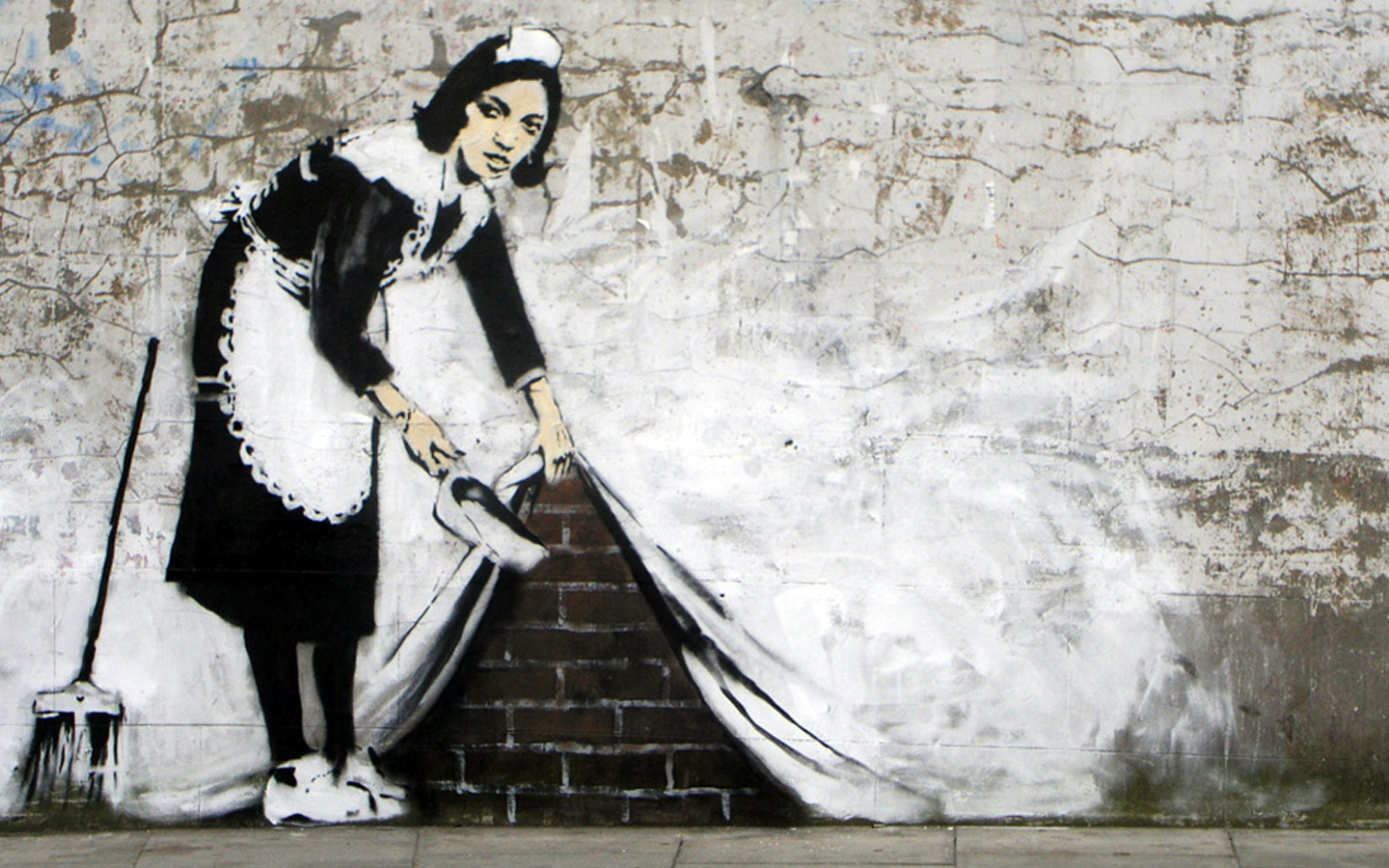
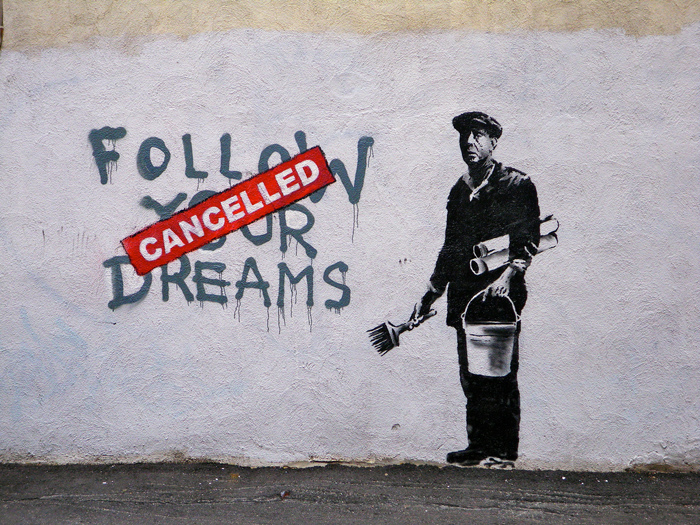

People are taking the piss out of you everyday. They but into your life, take a cheap shot at you and then disappear. They leer at you from tall buildings and make you feel small. They make flippant comments from buses that imply you’re not sexy enough and that all the fun is happening somewhere else. They are on TV making your girlfriend feel inadequate. They have access to the most sophisticated technology the world has ever seen and they bully you with it. They are The Advertisers and they are laughing at you. You, however, are forbidden to touch them. Trademarks, intellectual property rights and copyright law mean advertisers can say what they like wherever they like with total impunity. Fuck that. Any advert in a public space that gives you no choice whether you see it or not is yours. It’s yours to take, re-arrange and re-use. You can do whatever you like with it. Asking for permission is like asking to keep a rock someone just threw at your head. You owe the companies nothing. Less than nothing, you especially don’t owe them any courtesy. They owe you. They have re-arranged the world to put themselves in front of you. They never asked for your permission, don’t even start asking for theirs.---Banksy
Saw this on the Tumblr of one of our Pennsylvania readers.
Wednesday, February 15, 2012
A Resentful Retort to the Inanimate
by: Catherine Howard

We all have a trigger. That one phrase, that one off-handed comment, that one snide remark, that one cliché that makes us implode with fury. The Grove Book of Art Writing didn’t mean to hit that trigger. After all, it started out pretty chill between us. I mean, there was that touchingly intimate article about Bonnard’s life in his studio, about painting in a hollowed out space after the death of a lifelong partner, about pursuing beauty in the midst of grief-stricken depression. A few tears even welled up in my eyes. But then it had to go and make that stereotypical assumption that genius artists are male and that female artists are token aberrations. [Mumble, grumble, fume…]
Of the eighteen articles in the first section, “In the Studio: The Artist at Work”, only one is about a female artist’s studio. The New York critic Hilton Kramer is supposedly visiting sculptor Louise Nevelson. Now in the other writings in the section, artists are lauded for their personalities, for their intense focus. Writers fawned over the gritty nature of the “studio space”, drooled over the traces of “genius” left behind. However, instead of discussing Nevelson’s genius, Kramer references male artists Henry Moore, Alberto Giacometti, and David Smith – lauding them for their creative accomplishments – but what does he have to say about Louise Nevelson, one of the most talented contemporary sculptors, who by this point had work in the Museum of Modern Art’s collection?
“From the street, the house hardly looked like the sort of place where an artist, especially a sculptor, might be engaged in serious work.”Kramer goes on for another few paragraphs about the status of “sculpture” versus “painting” in the art market. Then he goes into a description of Nevelson’s home, with a passing appreciation of her productivity:
“It was certainly unlike anything one had ever seen or imagined. Its interior seemed to have been stripped of everything – not only furniture, rugs, and the common comforts of daily living, but of many mundane necessities – that might divert attention from the sculptures that crowded every space, occupied every wall, and at once filled and bewildered the eye wherever it turned.”But how is Nevelson truly treated? As an abberation. Her studio is strange, uncomfortable place, but where is she? She does not exist. All that is mentioned is this eccentric sculptural world that alludes to her existence. But where is she? There are no descriptions of her working, like in the other articles. No mentions of conversations with her. For all intents and purposes, Kramer is describing a haunted house. Louise Nevelson is the ghost.
As I continued to read The Grove Book of Art Writing, this disorienting imbalance persisted: no female artists speaking for themselves, only truncated mentions of women as anything more than models or caretakers. So if I am to be honest with myself (and you), why am I so angered by the oversight of female artists? Why do I take an imbalance of accounts in an anthology so personally that my skin crawls and my nostrils flare? I suppose it’s truly because this ignorant disrespect still catches me off-guard. After all, this book was written in 1998. 1998! My expectation when I pulled the book from the shelf would be that I would find guidance from other artists, insights into their perspectives and processes. But (once again), I realized that “art” wasn’t always for my kind of folk (you know, the kind of folk with vaginas).
And realizing that complaining without action rarely solves anything, my takeaway from this book will be Germaine Greer’s discussion of Artemisia Gentileschi’s artistic career:
“Artemisia did not choose to dwell on her disappointment. She refused to deal in pathos and softer emotions, and, as a result, alienated all those critics and historians of art who nurture the usual presuppositions about women. She developed an ideal of heroic womanhood. She lived it, and she portrayed it.”Touché… Back to the studio.
Labels: Art, Catherine Howard columns, Pop Culture, thought
Friday, February 03, 2012
Feminism, Art, modern context
To see her artwork, check out www.catherinejhoward.com, and to see more of her writing, check out catherinejhoward.wordpress.com.
Read her first piece on the Clarion Content here.

Answering Linda’s call
---Catherine J Howard
In an interview last summer, I was asked if I was a feminist. After wiping a quizzical look from my face, I replied, “Well… I am a woman. And I create artwork from that perspective… So… yes. I’m a feminist.” Only afterwards did I realize why the interviewer even bothered to ask me that question. He was providing me an out--- an opportunity to back-pedal with, “Nononono! You see I just…” [cue self-effacing attempts to not seem like a heinous “feminist” bitch]. You see… I forgot that “feminist” is still used as a derogatory term in some places. So, I began to wonder: why is it that a female artist who creates artwork that openly discusses women’s issues can still be brushed off as a stereotypically overly-dramatic dissident? “Off to the library!” I said (because I am obviously an uppity, bookish, prude). And, whaddya know, I found that I am not the first to question why honest, socially conscious artwork seemed errant coming from a female artist.
In her 1995 essay, "Why Have There Been No Great Women Artists?" Linda Nochlin attacks attempts to justify female "greatness" as different from what has been labeled as (male-centric) "genius".
“The problem lies not so much with some feminists' concept of what femininity is, but rather with their misconception - shared with the public at large - of what art is: with the naive idea that art is direct, personal expression of individual emotional experience, a translation of personal life into visual terms. Art is almost never that, great art never is.” [italics added for emphasis]
When I tossed this essay into a conversation with a group of female artists, the response was a slew of knee-jerk reactions of "Who does she think she is?! My work is mine. My personal expression!" However, Nochlin isn't invalidating women's need to create. In fact, she lauds female artists for finding creative outlets, no matter the social pressures for them to abandon those needs. Nochlin is instead exposing the reality that the social support systems that allowed "Great Artists" to develop were only endowed to men. Rather than saying that female accomplishment is just “naturally” different than male accomplishment, she challenges women not to settle for segregated creative expression but to demand equal opportunities and create work that lives up to the label “genius”:
“What is important is that women face up to the reality of their history and present situation, without making excuses or puffing mediocrity. Disadvantage may indeed be an excuse; it is not, however, an intellectual position. Rather, using as a vantage point their situation as underdogs in the realm of grandeur, and outsiders in that ideology, women can reveal institutional and intellectual weaknesses in general, and, at the same time that they destroy false consciousness, take part in the creation of institutions in which clear thought – and true greatness – are challenges open to anyone, man or woman, courageous enough to take the necessary risk, the leap into the unknown.” [italics added for emphasis]Whether you claim the label “feminist” or not, we cannot deny that if young female artists are still being marginalized for addressing issues surrounding the female body, the playing field isn’t as equal as we would like to think. Now, I will be the first to say that creating work that is even remotely confrontational, especially about issues dealing with sexuality, is terrifying. Honesty is never easy. However, this discomfort is exactly why female artists have the power and opportunity to broaden so-called “universal” perspectives that are still largely male-derived. Yet too many of us are bogged down in making art into another form of diary. Rather than taking a stand and challenging others to change their perceptions of the world, we degrade our creative voices and sideline it as sugar-coated “self-expression”. We churn out the palatable mediocrity that Nochlin rightfully despises. Ladies, Linda challenges you to dive into your studio practice and make your creative voice pointed, thoughtful, vibrant, and public. She challenges you to create and demand recognition for courageous, horizon-expanding work. I’m ready to embrace this challenge.
Care to join me?
Labels: Art, Catherine Howard columns, Pop Culture, thought
Tuesday, January 31, 2012
Clouds of Meaning
Words and meaning analogize well with clouds. Clouds are never stagnant, they are always in motion, nor do they ever have perfectly defined edges, the edge is Heisenbergian1, uncertain, and viewed through the lens of the observer. Further all the clouds interact in an especially complex and co-related way in the ecosystem that is the Earth's atmosphere, much as words and language do in our human travels. Butterfly wings on the other side of the language world resonate.
Notes
1Those seeking the meaning of words and subsequently adopting them as part of their vocabulary effect the very meaning of said words through this process.
Wednesday, November 16, 2011
Things that make you go, hmmmm...
This side by photo, maybe not so new to you, but new to the Clarion Content's editors made us stop and go, hmmmm...

Labels: photos, science, thought
Friday, November 11, 2011
This day...

The Clarion Content's editorial board is darned near pacifist. But that has never stopped us, nor will it ever stop us from humbly and gratefully thanking our soldiers and all those who serve male and female. Today is a day to remember those folks; those who serve and those who have served. And those who have made the ultimate sacrifice.
Do not distance yourself from their work. They come from your state, your city, your town, down the road and up the block. They are your friends and neighbors.
And until pacifism triumphs, we are in awe of this sacrifice. We are suffused with gratitude for those who make it, and thereby enable us to live in a mostly free, constitutionally governed country.
Labels: thought
Friday, October 07, 2011
Open Letter to the News & Observer
Is texting vernacular just e.e. cummings shaken and stirred?
Hardly says Clarion Content guest columnist, poet and writer, Amber C. Crews. Ms. Crews pulls no punches with her take on an article penned by Taryn Oesch here in the Raleigh News and Observer. Ms. Oesch blithely asserts, "I've decided that 21st-century communication - email, Facebook, text messages - aren't a breakdown of human interaction and relationships, but a form of poetry." Like Ms. Crews, our editor's instinctive reaction upon reading that line was, "Wait. What?" We love that there are people who feel passionately about the state of poetry in our era.

Stretching the limits of Facebook...
We warn you, as we often do, dear readers, the following letter, which is from the heart and the gut, is PG-13, like a lot of excellent poetry.
"You’ve got to be kidding me, or we are all fucked."
-Amber C. Crews
If the opinions of Taryn Oesch in her article "In our text updates, we are making poetry and connections" are at all representative of our cultural attitude towards art and community, then we are all fucked. (Read it here.) As a poet and writer, I have a close relationship with words and meaning. Ms. Oesch proposes that "[t]he purpose of poetry is to get as much meaning and feeling across as you can in as few words as possible. Aren’t texts and Facebook statuses the same concept?"
I don’t want to get into an argument about the definition of art and its purpose. It has been debated ad nauseam and art is becoming increasingly difficult to define in the 21st century. But you have to be kidding me. Facebook status updates and texting are poetry? I have looked over the shoulders of more than a few friends, just curious about the whole Facebook thing, not having a personal account, and I remember a bunch of pictures, random quotes, and song lyrics, and status update gems like "like if you have That one friend who will borrow stuff from you & never give it back" and "that awkward moment When you have too much lotion on and don`t know where to put it."
Looking at my own text inbox now, I see "Please tell me you are enjoying this gorgeous day!" "Yep!" and "Can I borrow one egg pleeaaasseee!?" Grammar is largely out the window, context an idea of the past, and nothing exists that is not instantly forgettable.
I don’t know how other poets work, but when I’m creating a poem each word, punctuation mark, and even every space on the page is labored over, thought about, tweaked, laboriously re-written, all in the search for the perfect combination that will express the precise image, feeling, and meaning that I intend. I highly doubt that is what’s going on with the light speed, verbal vomit that litters cell phones and internet pages. Ms. Oesch states that “Some say it’s ridiculous, the need to put everything on Facebook. I say it’s fundamental self-expression. It’s art in its most basic form.” If Facebook and text messaging represent our cultural “self-expression,” our creative power, our ability to reflect and propose new ways of seeing the world, then again, I say, we’re all fucked. Art, writing, and the courageous exploration of new thought are what balance all the depression, debt, death, and darkness of this chaotic universe. To see the human spirit soar in something challenging or moving, anything that gets you to think, gives meaning to life. If I am looking into a future where all that is boiled down to unconscious streams of cyber-messaging . . . I can’t think of a more desolate existence pretending to be connection.
Labels: Guest columns, Language, thought
Friday, September 02, 2011
Sweet Tweets
From Nikon is Love...the internal query, "Into me or into getting into me? #singlegirlproblems"
From Canadian Andrew Classon a youthful political perspective, “California aint a state its a army” [sic]
For those who don't speak the Twitter jargon a # is a hashtag, which indicates a subject or topic of the tweet.
Labels: Politics, thought, twitter
